Best Time To Visit DR Congo for Gorilla Trekking and Wildlife Safaris
The best time to visit DR Congo for gorilla trekking and wildlife safaris is during the dry seasons from December to February and June to September when trails in Virunga National Park and Kahuzi-Biega National Park are less muddy, vegetation thins for better wildlife viewing, and access to conservation areas improves. The current period in February 2026 falls within the primary dry season, offering optimal conditions for primate tracking and safari activities. Travel planning must account for active security concerns in North and South Kivu provinces where armed conflict continues between government forces and the M23 group.
Dry seasons (December to February and June to September) provide the best conditions for gorilla trekking in DR Congo with less muddy trails and better wildlife visibility. February 2026 is currently within the optimal dry season window. Security conditions remain unstable in eastern provinces with M23 occupation of Goma and Bukavu requiring careful itinerary planning. Gorilla permits must be booked 6 to 12 months in advance through registered tour operators. Wet seasons (March to May and October to November) bring heavy rainfall, difficult trail conditions, and limited park access.
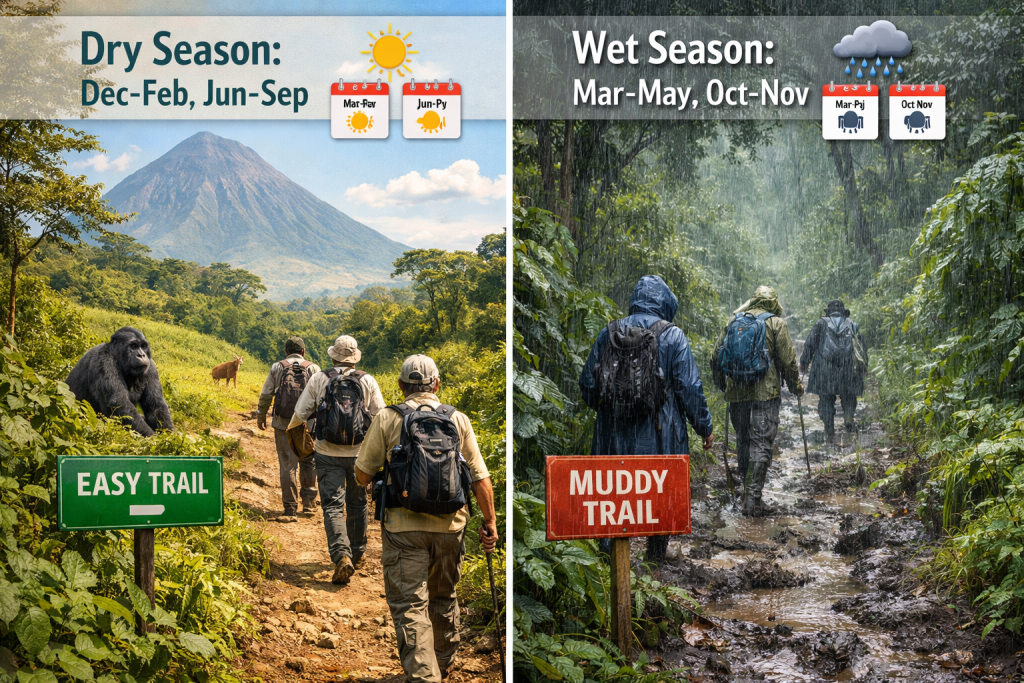
DR Congo’s dry seasons from December to February and June to September offer the most reliable conditions for gorilla trekking and wildlife safaris. Trail conditions improve during these months as rainfall decreases, making forest trekking safer and more comfortable. Wildlife viewing becomes easier as vegetation thins and animals concentrate around water sources. Security conditions in 2026 require visitors to avoid North and South Kivu provinces where active fighting continues, limiting access to some conservation areas.
DR Congo Dry Season Travel: December to February
The December to February dry season represents the primary window for gorilla trekking in DR Congo. Rainfall decreases across Virunga National Park and Kahuzi-Biega National Park, creating firmer trail surfaces and reducing the risk of slips on steep mountain slopes. The current period in mid-February 2026 places visitors within this optimal travel window.
Temperature ranges remain stable between 15°C and 25°C in highland areas where mountain gorillas live. Morning temperatures can drop to 10°C at higher elevations, requiring layered clothing for early trekking starts. Midday conditions warm up, making lightweight, moisture-wicking fabrics practical for forest hiking.
Vegetation density decreases during dry months, improving visibility for wildlife photography and primate observation. Gorilla families become easier to locate as they move through thinner undergrowth. Tracking times average 2 to 6 hours depending on gorilla group movements and terrain difficulty.
Park access improves during dry conditions as roads and trails require less maintenance. Four-wheel-drive vehicles can navigate routes that become impassable during wet months. Transfer times between lodges and park entry points decrease when roads remain dry.
DR Congo Wet Season Conditions: March to May and October to November

The wet seasons from March to May and October to November bring heavy rainfall to DR Congo’s conservation areas. Daily precipitation increases significantly, creating muddy trail conditions that slow trekking progress and increase physical difficulty. Trails in Virunga National Park become slippery, requiring extra caution on steep volcanic slopes.
Vegetation grows dense during wet months, reducing visibility and making wildlife observation more challenging. Gorilla tracking becomes more difficult as thick undergrowth obscures movement and increases the time needed to locate habituated groups. Photography conditions decline with lower light levels under heavy cloud cover.
Road conditions deteriorate during wet seasons, extending transfer times and limiting access to remote park sections. Some routes become impassable without specialized vehicles and experienced drivers. Lodge availability may decrease as operators reduce services during low-season periods.
Visitor numbers drop during wet months, creating opportunities for more private gorilla trekking experiences. Permit availability increases, and some operators offer reduced rates for wet season bookings. Travelers willing to manage difficult conditions can benefit from lower costs and fewer crowds.
Virunga National Park Gorilla Trekking Season Planning
Virunga National Park operates gorilla trekking year-round, but dry season months provide the most reliable conditions. The park protects eight habituated mountain gorilla families available for visitor tracking. Daily permits limit group sizes to eight people per gorilla family, creating strict capacity controls.
Permit bookings open 6 to 12 months in advance through registered tour operators. Costs vary by season and booking channel, with prices typically ranging from $400 to $1,500 per permit depending on park policies and operator packages. Advance booking becomes critical during peak dry season months when permits sell out.
Trekking starts at 7:00 AM from park headquarters after briefing sessions covering gorilla behavior rules and safety protocols. Visitors must maintain a seven-meter distance from gorillas and limit observation time to one hour once contact occurs. Physical fitness requirements are moderate to high, with treks involving steep climbs at elevations between 2,300 and 4,000 meters.
Security protocols in Virunga National Park include armed ranger escorts and restricted movement zones. The park suspended tourism operations multiple times in recent years due to armed group activity. Visitors must verify current operational status before booking as closures can occur with limited notice.
Kahuzi-Biega National Park Eastern Lowland Gorilla Tracking
Kahuzi-Biega National Park protects eastern lowland gorillas, a different subspecies from Virunga’s mountain gorillas. The park operates tracking activities during dry seasons when trail conditions allow safe access to gorilla territories. Lowland gorilla groups live at lower elevations than mountain gorillas, typically between 900 and 2,400 meters.
Tracking difficulty varies based on recent gorilla movements and terrain conditions. Treks can last 1 to 4 hours through dense rainforest vegetation. The park maintains fewer habituated gorilla families than Virunga, limiting daily visitor capacity and requiring early permit booking.
Permit costs for Kahuzi-Biega typically range lower than Virunga rates, though exact pricing changes based on park management policies. Visitors must book through licensed operators who coordinate permits, transport, and accommodation. Independent permit purchases are not available for most international visitors.
Security conditions around Kahuzi-Biega require careful assessment before travel. The park lies in South Kivu province where armed group activity continues. Recent travel advisories warn against all travel to North and South Kivu provinces due to M23 occupation of major cities and ongoing fighting.
DR Congo Security Conditions and Travel Restrictions in 2026

Security conditions in DR Congo remain unstable in 2026, particularly in eastern provinces. The M23 armed group occupies Goma and Bukavu, the main cities in North and South Kivu provinces where Virunga National Park and Kahuzi-Biega National Park are located[4]. Active fighting between armed groups and government forces continues, creating unpredictable risks for travelers.
Multiple government travel advisories recommend avoiding all travel to North and South Kivu provinces. The United States Department of State maintains a Level 4 travel advisory (Do Not Travel) for DR Congo, citing crime, civil unrest, and kidnapping risks. Canadian and British governments issue similar warnings against non-essential travel to eastern provinces.
Recent drone attacks against DR Congo prompted updated travel advisories on February 13, 2026. A security alert for Bangoka International Airport in Kisangani was issued on February 5, 2026, indicating ongoing threats to aviation infrastructure. These incidents demonstrate the fluid nature of security conditions requiring constant monitoring.
Travelers who proceed despite advisories must work with experienced local operators who maintain current security intelligence. Itineraries should include contingency plans for rapid evacuation if conditions deteriorate. Travel insurance policies must explicitly cover conflict zones, as standard policies typically exclude war-risk areas
Climate and Weather Patterns Across DR Congo Safari Destinations
DR Congo’s climate varies by region and elevation. Lowland areas experience equatorial conditions with high humidity and temperatures between 25°C and 30°C year-round. Highland regions where gorillas live see cooler temperatures ranging from 10°C to 25°C depending on elevation and time of day.
Rainfall patterns follow two distinct wet seasons and two dry seasons annually. The long wet season runs from March to May, bringing the heaviest precipitation. A shorter wet season occurs from October to November. Dry seasons span December to February and June to September, with June to September typically receiving the least rainfall.
Humidity remains high throughout the year in forest areas, typically above 70 percent. Morning mist and fog are common in mountain regions, clearing by mid-morning during dry seasons. Cloud cover persists longer during wet months, reducing daylight hours suitable for wildlife viewing.
Temperature variation between day and night increases during dry seasons. Morning temperatures can drop significantly, requiring warm layers for early trekking starts. Midday heat in lowland areas remains consistent year-round, making sun protection and hydration critical for all safari activities.
Gorilla Trekking Permits: Booking Timeline and Requirements
Gorilla trekking permits in DR Congo require advance booking through licensed tour operators. Individual travelers cannot purchase permits directly from park authorities in most cases. Operators handle permit applications, payment processing, and coordination with park management.
Booking timelines extend 6 to 12 months before planned travel dates during peak dry seasons. Permit availability decreases rapidly for popular months, particularly December to February when conditions are most favorable. Wet season permits show better availability and may be bookable with shorter lead times.
Permit requirements include passport details, age verification (minimum 15 years old), and health declarations. Visitors showing symptoms of contagious illness on trekking day will be denied entry to protect gorilla populations. No refunds apply for health-related cancellations on the day of trekking.
Permit costs vary by park and season. Virunga National Park historically charged between $400 and $1,500 per permit, though rates change based on park funding needs and conservation priorities. Kahuzi-Biega permits typically cost less but exact pricing requires operator confirmation. Permits are non-transferable and valid only for specified dates and gorilla groups.
Wildlife Viewing Beyond Gorilla Trekking in DR Congo National Parks
Virunga National Park protects diverse wildlife beyond mountain gorillas. The park contains savannah sections in the north where lions, elephants, hippos, and buffalo live. Game drives in these areas operate during dry seasons when roads remain passable. Wildlife concentrations increase around water sources as the dry season progresses.
Chimpanzee tracking operates in forest sections of Virunga, offering an alternative primate experience. Habituated chimpanzee communities allow visitor observation following similar protocols to gorilla trekking. Tracking difficulty varies as chimpanzees range over larger territories than gorilla families.
Bird watching opportunities exist year-round across DR Congo’s varied ecosystems. Virunga protects over 700 bird species, including Albertine Rift endemics. Kahuzi-Biega’s rainforest habitat supports different bird communities. Dry seasons provide better visibility for birding, though some species are more active during wet months.
Nyiragongo volcano trekking operates from Virunga National Park when security conditions permit. The volcano contains an active lava lake visible from the crater rim. Treks require one full day with overnight camping at the summit. This activity suspends during periods of increased volcanic activity or security threats.
Accommodation Options and Safari Lodge Availability
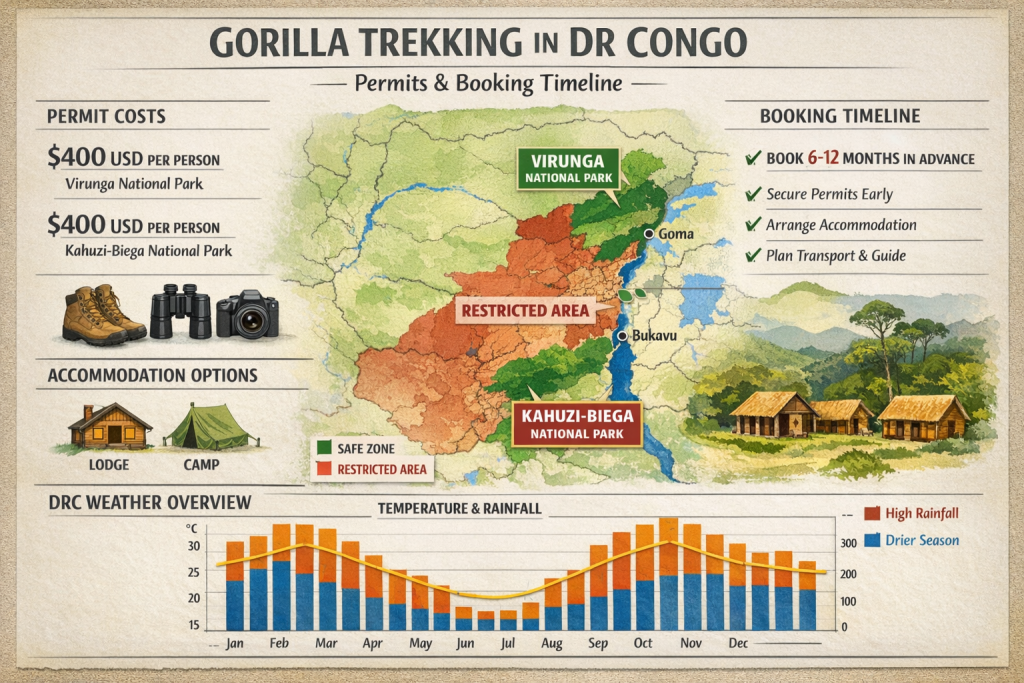
Safari lodges near Virunga National Park and Kahuzi-Biega National Park range from budget guesthouses to premium eco-lodges. Availability decreases during peak dry season months when advance booking becomes necessary. Wet season periods show better availability with some properties offering reduced rates.
Lodges near Virunga National Park concentrate around Goma and park entry points. Properties range from basic rooms with shared facilities to private cottages with en-suite bathrooms. Power supply can be intermittent, with many lodges operating on generators or solar systems. Hot water availability varies by property level.
Kahuzi-Biega accommodation options are more limited than Virunga. Visitors typically stay in Bukavu or smaller towns near park boundaries. Road conditions between accommodation and park entry points affect transfer times, particularly during wet seasons. Four-wheel-drive vehicles are standard for all transfers.
Security conditions in 2026 have affected lodge operations in eastern DR Congo. Some properties have suspended operations due to armed conflict in North and South Kivu provinces. Travelers must verify accommodation status through operators before booking as closures can occur without advance notice.
Health Requirements and Vaccination Planning for DR Congo Travel
Yellow fever vaccination is mandatory for entry to DR Congo. Travelers must present valid yellow fever certificates at immigration. The vaccination must be administered at least 10 days before arrival. This requirement applies to all visitors regardless of origin country.
Malaria prevention is required for all lowland areas of DR Congo. Prophylactic medication should begin before arrival and continue for the specified period after departure. Mosquito bite prevention through insect repellent, long sleeves, and treated bed nets reduces infection risk. Highland areas above 2,000 meters show lower malaria transmission rates.
Routine vaccinations should be current, including hepatitis A and B, typhoid, and tetanus. Polio vaccination may be required depending on origin country and recent outbreak status. Rabies vaccination is recommended for travelers spending extended time in rural areas or working with animals.
Travel health insurance must cover medical evacuation as local healthcare facilities are limited. Serious medical conditions require evacuation to Kenya, Uganda, or South Africa. Insurance policies must explicitly cover conflict zones as DR Congo’s security status may trigger exclusions in standard policies.
Visa Requirements and Entry Procedures for DR Congo
Visas are required for most nationalities visiting DR Congo. Tourist visas must be obtained before arrival through DR Congo embassies or consulates. Visa on arrival options are limited and unreliable. Processing times vary by location, typically requiring 5 to 15 business days.
Visa applications require valid passports with at least six months remaining validity and two blank pages. Application forms, passport photos, yellow fever certificates, and proof of accommodation are standard requirements. Fees vary by nationality and visa type, typically ranging from $100 to $300.
Entry procedures at Kinshasa and other international airports include immigration checks, yellow fever certificate verification, and customs declarations. Visitors must declare currency amounts exceeding $10,000. Photography restrictions apply at airports and government buildings. Travelers should avoid photographing military or police installations.
Border crossing procedures can be unpredictable. Land borders with Uganda and Rwanda near Virunga National Park experience periodic closures due to security conditions. Travelers should verify border status before planning overland entries. Armed conflict in border regions creates additional risks for land crossings in 2026.
Photography and Camera Equipment for DR Congo Wildlife Safaris
Camera equipment for gorilla trekking requires weatherproofing and portability. Rainfall can occur even during dry seasons, making rain covers or waterproof bags necessary. Cameras must be carried in padded backpacks during forest treks over uneven terrain. Weight limits are not enforced but lighter setups reduce fatigue during multi-hour treks.
Lens selection balances reach and light-gathering ability. Gorilla viewing occurs at close range (seven meters minimum), making 70-200mm or 100-400mm zoom lenses suitable. Forest conditions create low light levels requiring lenses with f/2.8 to f/5.6 maximum apertures. Image stabilization helps compensate for hand-held shooting on uneven ground.
Flash photography is prohibited during gorilla trekking. Sudden flashes can disturb gorillas and trigger defensive behavior. High ISO capability (3200 to 6400) becomes necessary for proper exposure in dark forest conditions. Noise reduction in post-processing helps manage grain from high ISO settings.
Backup equipment is recommended as camera repairs are unavailable in DR Congo. Dust and humidity can damage electronics, making protective storage important between shooting sessions. Extra batteries and memory cards should exceed estimated needs as replacement purchases are difficult. Power supply for charging equipment may be limited to generator hours at some lodges.
Cultural Etiquette and Local Customs in DR Congo
French is the official language in DR Congo, though Lingala, Swahili, Kikongo, and Tshiluba are widely spoken. English proficiency is limited outside tourist operations. Basic French phrases help with local interactions. Tour guides typically speak English for international visitors.
Dress codes lean conservative, particularly outside tourist areas. Long pants and covered shoulders are appropriate for most situations. Revealing clothing can attract unwanted attention. Trekking attire should prioritize function over fashion, with long sleeves and pants protecting against vegetation and insects.
Photography permissions are required before photographing people. Many locals expect payment for posed photos. Military, police, and government buildings must not be photographed. Violations can result in camera confiscation, detention, or demands for bribes.
Currency is the Congolese franc, though US dollars are widely accepted in tourist areas. Small denomination bills ($1, $5, $10) are useful as change availability is limited. Credit card acceptance is rare outside major hotels. ATMs are unreliable, making cash planning critical. Money should be carried securely as petty theft occurs.
Transportation and Internal Travel Within DR Congo
International flights to DR Congo arrive at Kinshasa’s N’djili Airport. Domestic connections to Goma (for Virunga National Park) operate on Congo Airways and smaller carriers. Flight schedules are subject to delays and cancellations. Overland travel from Kinshasa to eastern provinces is not practical due to road conditions and security risks.
Charter flights provide access to remote conservation areas when commercial options are unavailable. Operators arrange charters for safari packages when group sizes justify costs. Charter availability depends on aircraft maintenance and fuel supply, which can be unpredictable.
Road travel in eastern DR Congo requires four-wheel-drive vehicles and experienced drivers. Paved roads are limited, with most routes consisting of dirt tracks that deteriorate during wet seasons. Travel times between destinations can be three to four times longer than distance would suggest. Security checkpoints are common, requiring patience and proper documentation.
Vehicle rental without drivers is not recommended for international visitors. Local operators provide vehicles with drivers who understand road conditions, security situations, and checkpoint procedures. Self-driving exposes travelers to risks they are not equipped to manage.
Cost Planning and Budget Considerations for DR Congo Safaris
Gorilla trekking permits represent the largest single expense for DR Congo safaris. Virunga permits range from $400 to $1,500 depending on season and booking channel. Kahuzi-Biega permits typically cost less but require operator confirmation. Multiple treks increase costs proportionally.
Accommodation costs vary widely by property level. Budget guesthouses start around $30 to $50 per night. Midrange lodges cost $100 to $200 per night. Premium eco-lodges can exceed $300 per night. Rates may include meals at higher-end properties but not at budget options.
Transportation costs include international flights to Kinshasa, domestic flights to Goma or other regional hubs, and ground transfers. Domestic flights cost $200 to $500 one-way depending on route and booking timing. Ground transfers are typically included in operator packages but can cost $50 to $150 per day if arranged separately.
Guide and porter fees apply for gorilla trekking. Porters assist with carrying daypacks and provide stability on difficult terrain, costing $10 to $20 per trek. Tips for guides and rangers are customary, typically $10 to $20 per person per day. These costs are separate from permit fees.
FAQ
When is the best time to visit DR Congo for gorilla trekking?
The best time to visit DR Congo for gorilla trekking is during the dry seasons from December to February and June to September when trails are less muddy and wildlife viewing improves. The current period in February 2026 falls within the optimal dry season window.
Is it safe to travel to DR Congo in 2026?
Security conditions in DR Congo remain unstable in 2026, particularly in North and South Kivu provinces where M23 armed groups occupy Goma and Bukavu. Multiple governments advise against all travel to eastern provinces where major national parks are located. Travelers who proceed must work with experienced operators and maintain flexible evacuation plans.
How much do gorilla trekking permits cost in DR Congo?
Gorilla trekking permits in Virunga National Park cost between $400 and $1,500 depending on season and booking channel. Kahuzi-Biega National Park permits typically cost less but exact pricing requires operator confirmation. Permits must be booked 6 to 12 months in advance during peak seasons.
What is the weather like during DR Congo’s dry season?
Dry season weather in DR Congo features reduced rainfall, temperatures between 15°C and 25°C in highland areas, and clearer skies. Morning temperatures can drop to 10°C at higher elevations. Humidity remains high year-round but trail conditions improve significantly compared to wet seasons.
Do I need a visa to visit DR Congo?
Most nationalities require visas to enter DR Congo. Tourist visas must be obtained before arrival through DR Congo embassies or consulates. Processing takes 5 to 15 business days. Yellow fever vaccination certificates are mandatory for entry.
How difficult is gorilla trekking in DR Congo?
Gorilla trekking in DR Congo requires moderate to high fitness levels. Treks last 2 to 6 hours over steep terrain at elevations between 2,300 and 4,000 meters in Virunga National Park. Trails can be muddy and slippery, particularly during wet seasons. Porters are available to assist with carrying equipment and providing stability.
Can I visit both Virunga and Kahuzi-Biega National Parks in one trip?
Visiting both Virunga National Park and Kahuzi-Biega National Park in one trip is logistically possible but complicated by security conditions in 2026. Both parks lie in conflict-affected provinces where M23 occupation and armed fighting continue. Road travel between parks carries security risks requiring careful operator planning.
What vaccinations do I need for DR Congo?
Yellow fever vaccination is mandatory for DR Congo entry. Malaria prophylaxis is required for lowland areas. Recommended vaccinations include hepatitis A and B, typhoid, tetanus, and polio. Rabies vaccination is advised for extended rural stays. Travelers should consult travel health specialists 6 to 8 weeks before departure.
How far in advance should I book DR Congo gorilla trekking?
Gorilla trekking permits should be booked 6 to 12 months in advance for dry season travel. Peak months from December to February and June to September sell out quickly. Wet season permits show better availability and may be bookable with 3 to 6 months lead time.
What should I pack for gorilla trekking in DR Congo?
Gorilla trekking packing lists should include waterproof hiking boots, long pants and sleeves, rain jacket, daypack, water bottles, high-energy snacks, insect repellent, sun protection, camera with rain cover, and gardening gloves for grabbing vegetation. Layers are important as temperatures vary by elevation and time of day.
Are there alternatives to gorilla trekking in DR Congo?
Alternatives to gorilla trekking in DR Congo include chimpanzee tracking in Virunga National Park, game drives in northern savannah sections, bird watching across diverse ecosystems, and Nyiragongo volcano trekking when security permits. These activities operate on similar seasonal patterns favoring dry months.
What is the minimum age for gorilla trekking in DR Congo?
The minimum age for gorilla trekking in DR Congo is 15 years old. This requirement protects both young visitors and gorilla populations from disease transmission risks. Age verification requires passport presentation at permit booking and on trekking day.
Key Takeaways
The best time to visit DR Congo for gorilla trekking and wildlife safaris is during dry seasons from December to February and June to September when trail conditions improve and wildlife viewing becomes easier. February 2026 currently falls within the optimal dry season window. Security conditions in eastern provinces remain unstable with M23 occupation of Goma and Bukavu requiring careful travel planning and operator selection. Gorilla trekking permits must be booked 6 to 12 months in advance through licensed operators, with costs ranging from $400 to $1,500 depending on park and season.
Wet seasons from March to May and October to November bring heavy rainfall, muddy trails, and difficult access conditions but offer lower costs and fewer crowds. Virunga National Park protects mountain gorillas while Kahuzi-Biega National Park offers eastern lowland gorilla tracking at lower elevations. Both parks require armed ranger escorts and operate within conflict-affected regions. Yellow fever vaccination is mandatory for entry, and malaria prophylaxis is required for lowland areas.
Travel insurance must explicitly cover conflict zones as standard policies typically exclude war-risk areas. Photography equipment requires weatherproofing and portability for forest trekking conditions. Cultural etiquette emphasizes conservative dress and photography permissions. Transportation relies on domestic flights to regional hubs followed by four-wheel-drive ground transfers. Total safari costs including permits, accommodation, transport, and guides typically range from $2,000 to $5,000 per person for multi-day itineraries.