Lomami National Park Dr Congo Wildlife Safaris and Conservation Tours
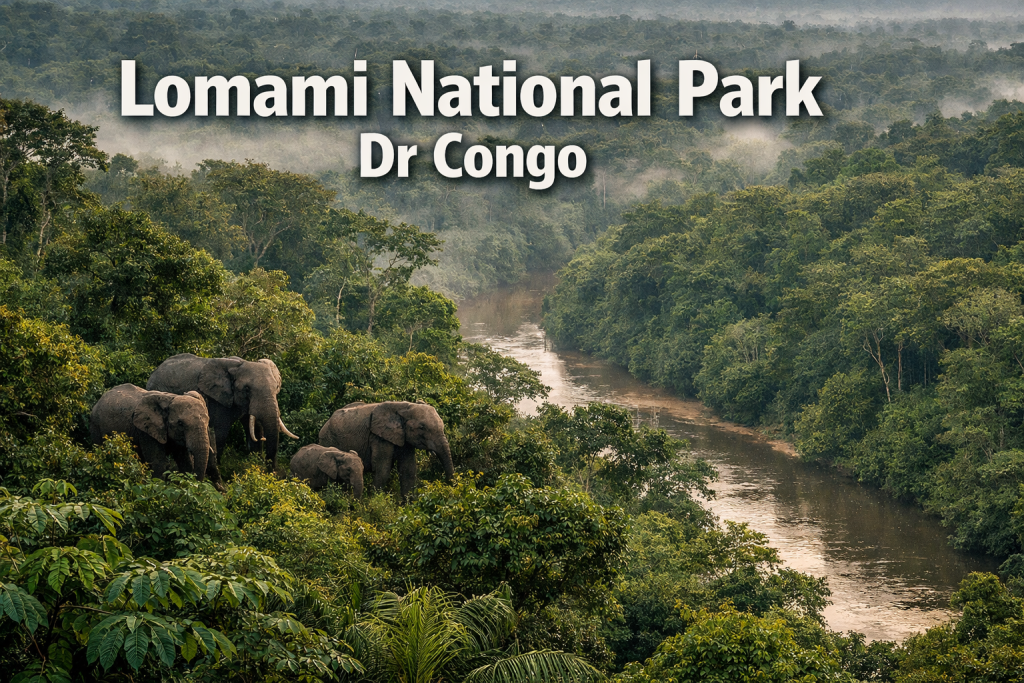
Lomami National Park Dr Congo is the Democratic Republic of Congo’s eighth and newest national park, officially established in July 2016 after a 45-year gap in protected area designation. Covering approximately 9,000 square kilometers in the central Congo Basin, the park protects rare primate species including the lesula monkey and Dryas monkey, alongside at least 500 African forest elephants, bonobo chimpanzees, okapi, and more than 275 documented bird species. The park operates through a community-based conservation model with local employment and joint patrols between Frankfurt Zoological Society and the Congolese Nature Conservation Institute.
Lomami National Park became the DRC’s first new national park since 1970 when it was established in July 2016 with strong community backing.
The park spans 9,000 square kilometers of Congo Basin rainforest and protects endemic primate populations, forest elephants, bonobos, and okapi.
Access requires advance planning through registered operators working with ICCN and Frankfurt Zoological Society, with visits limited to conservation-focused tourism and research activities.
Park guards and staff are recruited from surrounding communities and operate through seven surveillance camps positioned on park boundaries and within protected zones.
Wildlife viewing involves guided foot patrols in dense rainforest terrain with no guarantee of sightings, particularly for rare species like the lesula monkey.
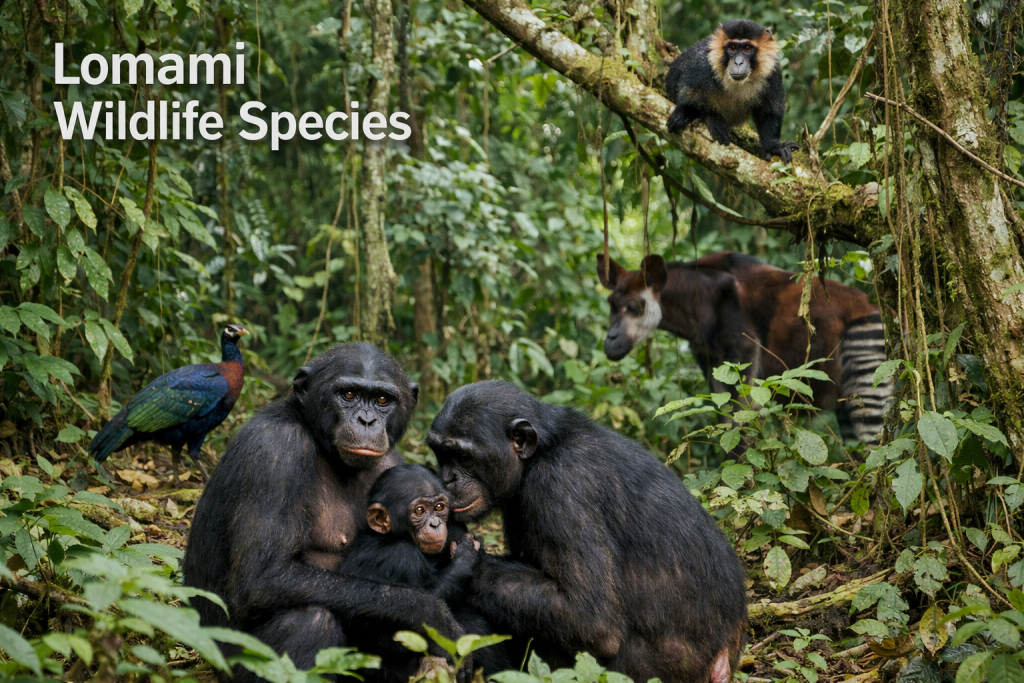
Lomami National Park Dr Congo is a 9,000-square-kilometer protected area in the central Congo Basin, established in 2016 to conserve rare primates, forest elephants, and okapi populations. The park operates through community-based conservation with local staff conducting joint patrols with ICCN rangers. Visitors planning safaris to Lomami National Park must arrange access through registered tour operators working directly with park management, as independent travel is not permitted and infrastructure remains limited to research and conservation operations.
Lomami National Park Dr Congo Location and Geography
Lomami National Park is located in the Tshopo and Maniema provinces of central Democratic Republic of Congo, positioned within the Congo Basin rainforest ecosystem. The park covers approximately 3,500 square miles, making it comparable in size to Yellowstone National Park in the United States.
The protected area takes its name from the Lomami River, which forms a natural boundary through the region. The terrain consists of lowland tropical rainforest with dense canopy cover, seasonal wetlands, and river systems that create distinct habitat zones for different wildlife populations.
Access to Lomami National Park requires overland travel from Kindu or Kisangani, the nearest major cities with airport facilities. Road conditions vary significantly by season, with the dry months of June through September offering better access than the rainy periods when many routes become impassable.
Wildlife Species in Lomami National Park Dr Congo
The park protects several primate species found nowhere else in the world or in extremely limited populations. The lesula monkey was scientifically described in 2012 and remains one of Africa’s most recently identified primate species, with Lomami National Park representing its primary protected habitat.
A population of Dryas monkeys, considered one of Africa’s rarest primates, was documented within the park boundaries during pre-establishment surveys. Other primate species include bonobo chimpanzees, Wolf’s monkeys, blue monkeys, and red-tailed monkeys, creating one of the highest primate diversity concentrations in central Africa.
Lomami National Park supports at least 500 African forest elephants, representing one of the DRC’s last viable elephant populations amid widespread poaching pressure in other regions. The park also protects okapi populations, the DRC’s endemic forest giraffe species that occurs only in Congo Basin forests.
Bird species documentation has identified more than 275 species, including the vulnerable Congo peafowl, a ground-dwelling bird endemic to the Congo Basin. Botanical surveys have recorded unusual plant species, with at least one new species, Xenostegia lomamiensis, formally published from park collections.
Lomami National Park Dr Congo Conservation Management
Frankfurt Zoological Society became the project leader and director of Lomami National Park in April 2016, operating under a co-management agreement with the Congolese Nature Conservation Institute. This partnership structure allows international conservation expertise to support local management capacity while maintaining Congolese government authority over the protected area.
Park protection operates through seven surveillance camps positioned on park borders and within the interior zones. These camps serve as bases for regular foot patrols conducted jointly by TL2 project staff and ICCN rangers to monitor wildlife populations and document poaching activities.
Staff recruitment prioritizes candidates from communities surrounding the park, creating local employment opportunities and building community investment in conservation outcomes. This approach differs from many African protected areas where ranger positions are filled from national recruitment pools without local preference.
Deforestation monitoring data from 2001 to 2024 indicates that 35 percent of tree cover loss within Lomami occurred in areas where the dominant drivers resulted in permanent deforestation rather than selective logging or natural disturbance. This data informs patrol deployment and identifies pressure points requiring increased protection effort.
Community-Based Conservation Model at Lomami National Park
Lomami National Park became the first national park in Congo and one of few in Africa to be established with major backing from local communities. This community support was developed through years of consultation and benefit-sharing discussions before the park received official designation in 2016.
Local communities participate in park management through employment as guards, guides, and support staff. This creates direct economic benefits from conservation rather than extractive activities like hunting or logging that characterized pre-park land use.
The community-based model addresses a common challenge in African conservation where protected areas are imposed on local populations without consultation or benefit-sharing. By involving communities from the planning stages, Lomami National Park established a foundation for long-term conservation success that depends on local support rather than external enforcement alone.
Revenue-sharing mechanisms allow communities to receive benefits from research permits, conservation tourism, and international funding directed toward park operations. These financial flows remain modest compared to high-volume tourism parks but provide tangible returns to communities that agreed to hunting and resource extraction restrictions.
Lomami National Park Dr Congo Safari Planning and Access
Visitors planning safaris to Lomami National Park must coordinate travel through registered tour operators with established relationships to ICCN and Frankfurt Zoological Society. Independent travel to the park is not permitted, and no public accommodation facilities exist within or immediately adjacent to park boundaries.
Safari itineraries typically involve multi-day expeditions with camping in designated zones under ranger supervision. Physical fitness requirements are high due to daily foot patrols through dense rainforest terrain with limited trail infrastructure and high humidity conditions.
The dry season from June through September offers the best access conditions, with lower water levels allowing river crossings and reduced mud on overland routes. The rainy season from October through May creates access challenges but concentrates wildlife around permanent water sources, potentially improving sighting opportunities for species like forest elephants.
Permits must be arranged weeks in advance through tour operators who coordinate with park management. Permit fees support park operations and community benefit programs, with costs varying based on visit duration and group size.
Wildlife Viewing Expectations at Lomami National Park
Wildlife viewing in Lomami National Park involves guided foot patrols through dense rainforest where sightings are never guaranteed and depend on factors beyond human control. The forest canopy limits visibility to 10 to 30 meters in most areas, and many species are cryptic or flee at the sound of human approach.
Primate sightings are most likely for habituated groups of blue monkeys and red-tailed monkeys that tolerate human presence. Bonobo chimpanzees and Wolf’s monkeys occur in the park but are shy and require extended tracking effort with no certainty of visual contact.
The lesula monkey and Dryas monkey populations represent the park’s most significant primate conservation value but are extremely difficult to observe. These species occur at low densities, occupy specific habitat zones, and show strong avoidance behavior toward humans. Visitors should not expect to see these rare primates during standard safari visits.
Forest elephant sightings depend on locating fresh sign and tracking to feeding or water areas. Elephants move across large territories and may be absent from accessible zones during a multi-day visit. When present, viewing distances are often limited by vegetation density.
Bird species diversity is high, but dense canopy conditions make identification challenging without experienced guides. The Congo peafowl is heard more often than seen and requires patient waiting near known territories for visual confirmation.
Lomami National Park Dr Congo Travel Logistics
Travel to Lomami National Park begins with international flights to Kinshasa, followed by domestic connections to Kindu or Kisangani. These regional hubs serve as staging points for overland travel to park access points, which can require one to three days depending on road conditions and vehicle type.
Tour operators arrange 4×4 vehicles suitable for rough road conditions, river crossings, and off-road sections where formal roads do not exist. Fuel, food supplies, and camping equipment must be carried from regional centers as no resupply points exist near the park.
Communication infrastructure is limited throughout the park region. Satellite phones provide the only reliable communication method, and visitors should not expect mobile phone coverage or internet access during park visits.
Medical facilities are absent within 100 kilometers of most park access points. Visitors must carry comprehensive medical kits and have evacuation insurance that covers remote area extraction by charter aircraft if serious injury or illness occurs.
Permits and Regulations for Lomami National Park Safaris
All visitors must obtain permits from ICCN before entering Lomami National Park. Tour operators handle permit applications, which require passport copies, detailed itineraries, and advance payment of park fees.
Group sizes are limited to minimize disturbance to wildlife populations and reduce environmental impact on sensitive forest ecosystems. Maximum group sizes vary by activity type but typically range from four to eight visitors plus required guides and rangers.
Wildlife viewing regulations prohibit approaching primates closer than seven meters to reduce disease transmission risk. Flash photography is not permitted for primate species, and visitors must follow ranger instructions regarding movement and noise levels during tracking activities.
Camping is restricted to designated zones with prior authorization. Open fires are prohibited in most areas due to forest fire risk, requiring visitors to use portable stoves for cooking.
Collection of plant or animal specimens, including insects and botanical samples, requires separate research permits and is not authorized under standard tourism permits.
Best Time to Visit Lomami National Park Dr Congo
The dry season from June through September provides optimal conditions for Lomami National Park safaris. Lower rainfall reduces mud on access routes, allows river crossings at more locations, and makes foot patrols less physically demanding.
Wildlife concentrates around permanent water sources during dry months, potentially improving sighting probabilities for elephants and larger mammals. Primate groups also show more predictable ranging patterns when water availability is limited.
The rainy season from October through May creates access challenges but offers advantages for bird photography as many species are in breeding plumage. Vegetation is greener and insect activity peaks, supporting higher bird diversity in accessible zones.
Temperature and humidity remain high year-round in the Congo Basin rainforest. Daytime temperatures typically range from 24 to 30 degrees Celsius with humidity above 80 percent in all months.
Lomami National Park Dr Congo Accommodation Options
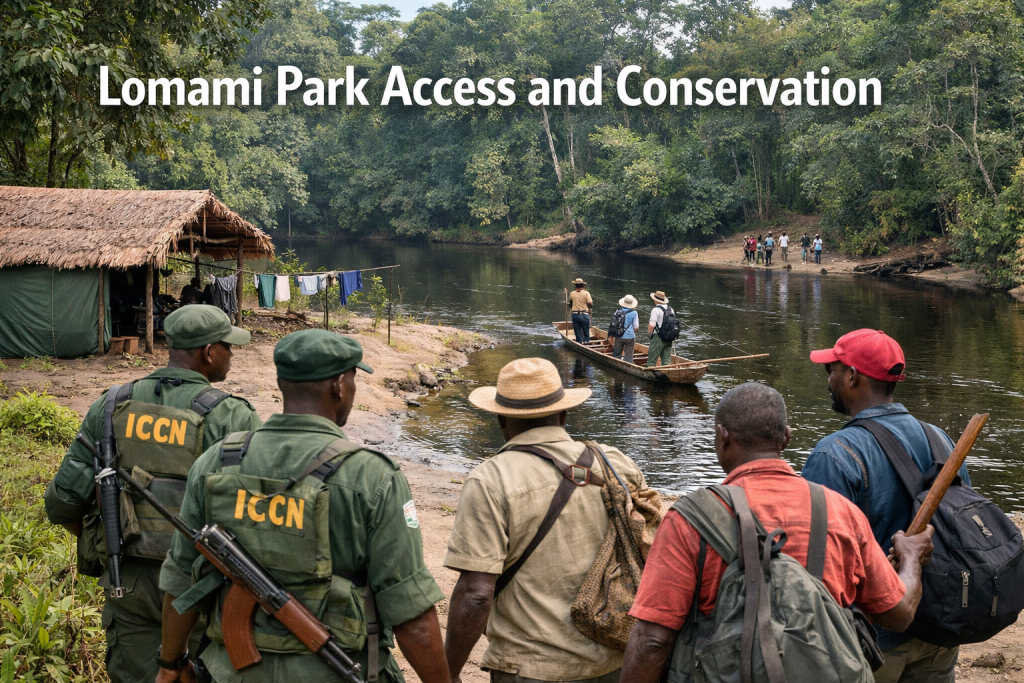
No permanent lodges or camps operate within Lomami National Park boundaries. All accommodation involves mobile camping with equipment provided by tour operators or research organizations.
Camping sites are basic clearings with no facilities beyond what visitors carry. Tents, sleeping gear, cooking equipment, water filtration systems, and food supplies must be self-sufficient for the entire visit duration.
Some tour operators maintain semi-permanent camp structures near park boundaries that serve as base camps for multi-day expeditions. These camps offer basic shelter but remain far below the standards of lodge-based safari accommodation found in East African parks.
Visitors should expect camping conditions similar to wilderness expeditions rather than structured safari camps. Toilet facilities are portable latrines, bathing involves river water or carried supplies, and sleeping conditions include forest sounds throughout the night.
Conservation Challenges Facing Lomami National Park
Poaching pressure continues despite park designation and patrol efforts. Commercial hunting for bushmeat and ivory remains economically attractive in a region with limited alternative income sources and weak law enforcement capacity.
Deforestation data showing 35 percent tree cover loss in specific zones indicates ongoing pressure from agricultural expansion and logging. Park boundaries are not physically demarcated in many sections, creating confusion about protected versus community-use areas.
Limited funding constrains patrol frequency and ranger equipment quality. While Frankfurt Zoological Society provides technical support, long-term conservation success requires sustained funding levels that exceed current commitments.
Climate change impacts on Congo Basin rainfall patterns may alter seasonal flooding cycles and water availability, affecting wildlife distribution and access conditions for both animals and rangers.
Research Opportunities at Lomami National Park Dr Congo
Lomami National Park supports ongoing research programs focused on primate ecology, forest elephant population dynamics, and botanical diversity. Research permits are available through ICCN for qualified scientists and graduate students conducting conservation-relevant studies.
Long-term monitoring programs track population trends for key species including lesula monkeys, Dryas monkeys, and forest elephants. These programs provide baseline data for assessing conservation effectiveness and identifying emerging threats.
Botanical research continues to document plant species diversity, with surveys identifying species new to science. The park’s relatively intact forest structure offers opportunities to study ecosystem processes in areas with minimal human disturbance.
Camera trap networks deployed throughout the park collect data on species presence, distribution, and behavior patterns. This non-invasive monitoring technique provides information on shy or nocturnal species rarely observed during foot patrols.
Lomami National Park Dr Congo Photography Safaris
Photography safaris in Lomami National Park face significant challenges due to dense vegetation, low light conditions under forest canopy, and wildlife wariness. Successful wildlife photography requires long telephoto lenses, high ISO capability, and patience for limited shooting opportunities.
Primate photography is restricted by minimum distance requirements and flash prohibitions. Fast lenses with image stabilization are necessary for hand-held shooting in low light conditions typical of rainforest understory.
Landscape photography opportunities are limited by canopy density that restricts open views. River scenes and forest edge habitats offer the best composition options for wider shots.
Photographers should carry weather-sealed equipment and protective covers for cameras and lenses. Humidity levels cause condensation issues when moving equipment between temperature zones, and rain can occur even during dry season months.
Health and Safety Considerations for Lomami National Park Safaris
Yellow fever vaccination is mandatory for entry to the Democratic Republic of Congo. Proof of vaccination must be presented at immigration and may be checked at domestic airports.
Malaria prophylaxis is required for all visitors to Lomami National Park, as the region has year-round malaria transmission. Visitors should consult travel medicine specialists for current prophylaxis recommendations and bring sufficient medication for the entire trip duration plus buffer days.
Water purification is necessary for all drinking water. Rivers and streams carry parasites and bacteria that cause serious illness. Portable filtration systems or chemical treatment tablets must be used for all water consumed.
Physical fitness requirements are high due to daily foot patrols in hot, humid conditions over uneven terrain. Visitors should be capable of walking four to six hours per day carrying day packs with water and personal items.
Comparison with Other Congo Basin National Parks
Lomami National Park differs from Virunga National Park and Kahuzi-Biega National Park, which offer more developed tourism infrastructure and habituated gorilla populations. Lomami focuses on forest ecosystem conservation rather than single-species tourism.
Salonga National Park, the DRC’s largest protected area, shares similar rainforest habitat but has even more limited access and visitor facilities than Lomami. Both parks protect bonobo populations and forest elephants but Salonga covers a much larger area.
Garamba National Park in northeastern DRC focuses on savannah wildlife including elephants and giraffes, offering a different ecosystem and species assemblage than Lomami’s rainforest environment.
Lomami National Park attracts visitors specifically interested in primate diversity, community-based conservation models, and wilderness experiences rather than high-volume wildlife viewing or luxury accommodation.
Lomami National Park Dr Congo Tour Operators and Booking
Tour operators specializing in Congo Basin travel include companies with established ICCN relationships and experience in remote area logistics. Operators should provide detailed pre-trip briefings, comprehensive equipment lists, and clear explanations of physical requirements.
Booking lead times of three to six months are recommended to allow permit processing, logistics coordination, and flight arrangements. Last-minute bookings are generally not possible due to permit requirements and limited access windows.
Tour costs reflect the high logistics demands of operating in remote areas with limited infrastructure. Prices typically include permits, guides, rangers, camping equipment, food, ground transport, and domestic flights but exclude international airfare and personal gear.
Group departures may be scheduled during dry season months, while private departures can be arranged year-round subject to access conditions and permit availability.
Cultural Considerations for Lomami National Park Visitors
Local communities near Lomami National Park include multiple ethnic groups with distinct languages and cultural practices. French serves as the common language for official communication, while local languages vary by specific community.
Photography of local people requires permission and often involves payment expectations. Visitors should ask guides to negotiate photo permissions and appropriate compensation before taking pictures.
Gift-giving to communities can create problematic expectations for future visitors. Tour operators with established community relationships handle benefit-sharing through structured programs rather than ad-hoc gifts from individual tourists.
Dress codes are conservative in rural DRC communities. Visitors should wear long pants and shirts that cover shoulders, avoiding clothing that may be considered disrespectful.
Lomami National Park Dr Congo Conservation Impact
Tourism revenue contributes to park operations and community benefit programs, creating economic incentives for conservation. The limited visitor numbers mean tourism income remains modest compared to international conservation funding.
Local employment through ranger positions and support roles provides direct benefits to communities that accepted resource use restrictions when the park was established. These jobs offer stable income in a region with few formal employment opportunities.
Research programs supported by park management generate scientific publications that raise international awareness of Lomami’s conservation value. This visibility helps maintain donor interest and funding flows.
The community-based establishment model serves as a potential template for other protected areas in the Congo Basin where top-down conservation approaches have failed to achieve lasting protection.
Frequently Asked Questions About Lomami National Park Dr Congo
What is the best time of year to visit Lomami National Park? The dry season from June through September offers the best access conditions with lower rainfall, better road conditions, and easier river crossings. Wildlife viewing does not vary dramatically by season due to year-round water availability in the rainforest environment.
Can visitors see the lesula monkey in Lomami National Park? The lesula monkey occurs in Lomami National Park but sightings are extremely rare due to low population density, specific habitat requirements, and shy behavior. Visitors should not expect to see this species during standard safari visits.
What permits are required for Lomami National Park safaris? All visitors need ICCN permits arranged through registered tour operators. Permit applications require passport copies, detailed itineraries, and advance payment, with processing times of several weeks.
Are there lodges in Lomami National Park? No permanent lodges or camps operate within park boundaries. All accommodation involves mobile camping with equipment provided by tour operators.
How do visitors reach Lomami National Park? Access requires international flights to Kinshasa, domestic flights to Kindu or Kisangani, then overland travel by 4×4 vehicle for one to three days depending on road conditions and specific access points.
What wildlife can visitors expect to see? Primate species including blue monkeys and red-tailed monkeys are most commonly observed. Forest elephants, okapi, and bonobo chimpanzees occur in the park but sightings are not guaranteed due to dense vegetation and wildlife wariness.
Is Lomami National Park safe for tourists? The park itself is managed for visitor safety, but the broader region has limited medical facilities and communication infrastructure. Visitors need comprehensive travel insurance with emergency evacuation coverage and should follow ranger instructions at all times.
What vaccinations are required for Lomami National Park? Yellow fever vaccination is mandatory for DRC entry. Malaria prophylaxis is required, and visitors should consult travel medicine specialists for current recommendations on other vaccinations.
How physically demanding are Lomami National Park safaris? Daily foot patrols of four to six hours through dense rainforest in hot, humid conditions require good fitness levels. Terrain is uneven with stream crossings and no developed trail infrastructure in most areas.
What is the difference between Lomami and other Congo parks? Lomami focuses on forest ecosystem conservation and primate diversity rather than single-species tourism like gorilla trekking. Infrastructure is minimal compared to Virunga or Kahuzi-Biega, attracting visitors interested in wilderness experiences.
Can independent travelers visit Lomami National Park? Independent travel is not permitted. All visits must be arranged through registered tour operators working with ICCN and Frankfurt Zoological Society.
What camera equipment is recommended for Lomami National Park? Long telephoto lenses, high ISO capability, and weather-sealed bodies are necessary for rainforest photography. Fast lenses with image stabilization help in low light conditions under forest canopy.
Key Takeaways About Lomami National Park Dr Congo
Lomami National Park was established in July 2016 as the DRC’s first new national park in 45 years, protecting 9,000 square kilometers of Congo Basin rainforest.
The park supports rare primate populations including lesula monkeys, Dryas monkeys, and bonobo chimpanzees, along with at least 500 forest elephants.
Community-based conservation defines the park’s management model, with local employment and benefit-sharing programs building support for protection measures.
Access requires advance planning through registered tour operators, with permits arranged weeks before travel and no independent visitor access permitted.
Wildlife viewing involves guided foot patrols through dense rainforest with no guarantee of sightings, particularly for rare or shy species.
The dry season from June through September provides optimal access conditions, while the rainy season creates travel challenges but supports higher bird diversity.
Accommodation is limited to mobile camping with no permanent lodges or facilities within park boundaries.
Physical fitness requirements are high due to daily foot patrols in hot, humid conditions over uneven terrain without developed trail infrastructure.
Conservation challenges include ongoing poaching pressure, deforestation in specific zones, and limited funding for patrol operations and ranger equipment.
Lomami National Park attracts visitors interested in primate diversity, community conservation models, and wilderness experiences rather than high-volume wildlife viewing or luxury accommodation.