Boyoma Falls Congo Travel Guide
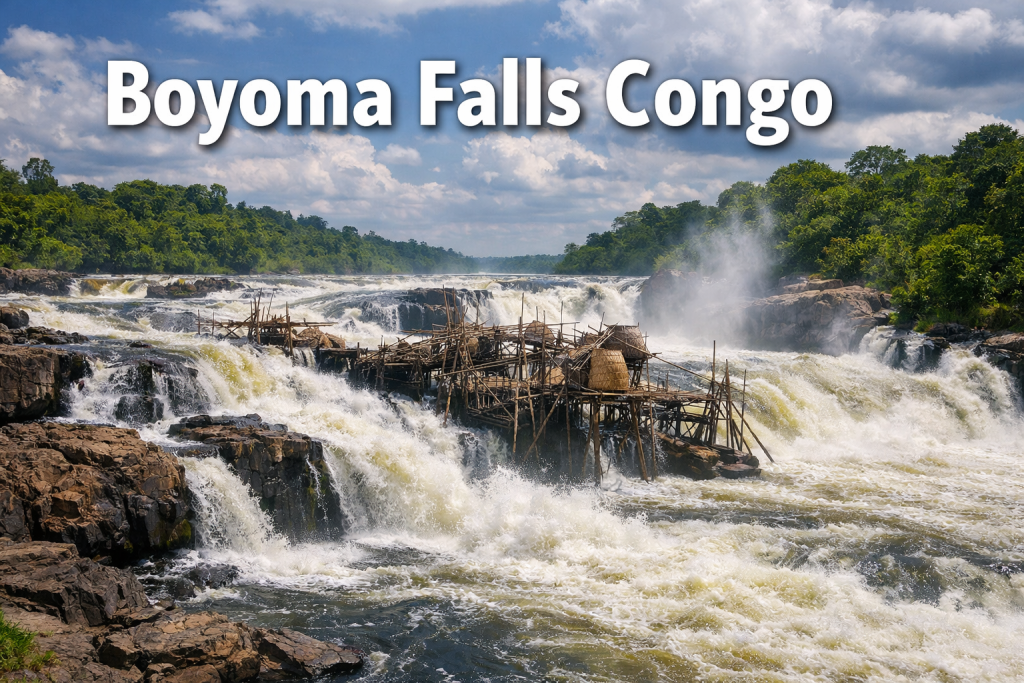
Boyoma Falls Congo consists of seven cataracts extending 100 kilometers along the Lualaba River between Ubundu and Kisangani in Tshopo Province, northeastern Democratic Republic of Congo. The falls drop a total of 61 meters over this distance, with the seventh cataract measuring 800 yards wide, making this one of the highest-volume waterfall systems globally, exceeding both Niagara and Iguazu Falls in total annual discharge. Visitors travel to Boyoma Falls to observe traditional Wagenia fishing methods, witness the transition point where the Lualaba River becomes the Congo River, and access one of Central Africa’s most powerful river systems.
Boyoma Falls is a 100-kilometer series of seven cataracts on the Lualaba River in northeastern DRC with a total drop of 61 meters. The falls system carries more water volume annually than Niagara or Iguazu Falls. Access is via Kisangani, reachable by air from Kinshasa or Goma. The Wagenia people practice traditional fishing using wooden structures in the rapids. Best travel period is June to September during the dry season. French and Swahili are the primary languages spoken in the region.
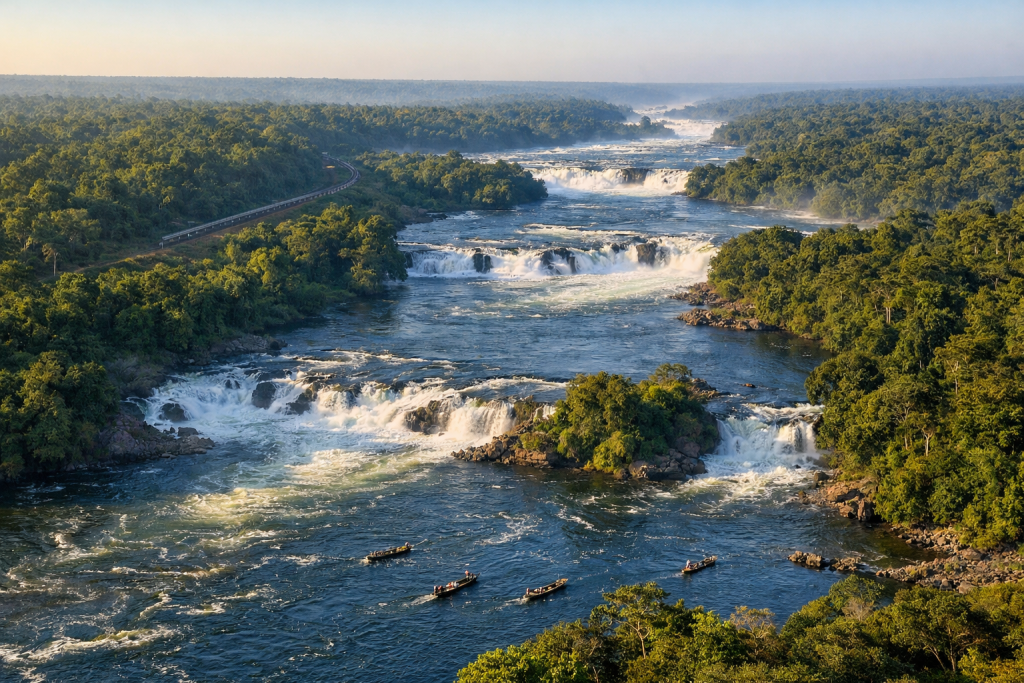
Boyoma Falls Congo is a 100-kilometer waterfall system on the Lualaba River in Tshopo Province, DRC, featuring seven distinct cataracts with a combined elevation drop of 61 meters. The falls mark the geographic point where the Lualaba River transitions into the Congo River, Africa’s second-longest river. Visitors access the falls through Kisangani, the nearest major city, during the dry season months of June through September when river levels are lower and travel conditions are more predictable.
Boyoma Falls Congo Location and Geography
Boyoma Falls is located in Tshopo Province in the northeastern Democratic Republic of Congo, stretching between the towns of Ubundu and Kisangani. The falls system spans 100 kilometers along the Lualaba River, which becomes the Congo River at this point.
The seven cataracts that form Boyoma Falls are distributed along this 100-kilometer stretch, with the seventh and largest cataract measuring approximately 800 yards (730 meters) in width. The total elevation drop across all seven cataracts is 61 meters (200 feet).
Kisangani serves as the primary access point for visitors traveling to Boyoma Falls. The city is positioned at the downstream end of the falls system and functions as a regional transport hub in northeastern DRC.
A railway line runs parallel to the falls, connecting the river ports at Kisangani and Ubundu. This rail infrastructure was built to circumvent the non-navigable rapids, allowing cargo and passengers to bypass the waterfall section of the river.
Boyoma Falls Congo Water Volume and River System
Boyoma Falls carries one of the highest water volumes of any waterfall system globally. The total annual discharge exceeds both Niagara Falls and Iguazu Falls, making it a hydrologically significant site in Central Africa.
The Lualaba River, which feeds Boyoma Falls, transforms into the Congo River at this location. The Congo River is the second-longest river in Africa and the deepest river in the world, with sections reaching depths over 200 meters.
Water flow at Boyoma Falls varies seasonally. During the rainy season (October to May), water levels rise and flow rates increase. The dry season (June to September) brings lower water levels, which can make the individual cataracts more visible and distinct.
The falls are not a single vertical drop but a series of cascades and rapids distributed over 100 kilometers. This configuration creates continuous whitewater sections interspersed with calmer pools between cataracts.
Wagenia Fishing at Boyoma Falls Congo
The Wagenia people (also spelled Wagenya) have fished at Boyoma Falls for centuries using a traditional method that involves wooden tripods and conical baskets. These structures are anchored directly in the rapids at specific points where fish are channeled by the current.
Fishermen construct large wooden tripods that extend into the rushing water. Conical woven baskets are suspended from these tripods, positioned to catch fish as they attempt to navigate upstream through the rapids. The design allows only mature fish to enter the baskets, functioning as a selective fishing method.
This fishing technique is passed down through generations and represents a form of traditional knowledge adapted to the specific conditions of Boyoma Falls. The wooden structures must be maintained regularly due to the force of the water and require skill to position correctly.
Visitors can observe Wagenia fishing operations from viewing points along the riverbank. The fishing structures are most visible during lower water levels in the dry season when more of the tripod framework is exposed above the waterline.
The Wagenia fishing method is recognized as a cultural heritage practice in the region. It provides a livelihood for local communities and represents one of the few traditional fishing techniques still actively practiced on this scale in Central Africa.
Boyoma Falls Congo Travel Access and Transport
Kisangani is the primary gateway for travel to Boyoma Falls Congo. The city has an airport with scheduled flights from Kinshasa, the capital of DRC, and from Goma in the eastern part of the country.
Air travel is the most reliable method to reach Kisangani. Road access to the region can be difficult due to infrastructure conditions, particularly during the rainy season when unpaved roads become impassable.
From Kisangani, visitors can arrange local transport to viewing points along the falls. The seventh cataract, being the largest and most accessible, is the most commonly visited section.
French and Swahili are the primary languages spoken in Kisangani and the surrounding region. Basic knowledge of French is useful for travel logistics and communication with guides and transport operators.
Visitors should arrange accommodation in Kisangani, as lodging options directly at the falls are limited. The city has hotels ranging from basic guesthouses to midrange properties.
Travel to the DRC requires a visa for most nationalities. Visa applications are processed through DRC embassies or consulates, and travelers should allow several weeks for processing. Yellow fever vaccination is mandatory for entry into the DRC, and proof of vaccination must be presented at immigration.
Best Time to Visit Boyoma Falls Congo
The dry season from June to September is the recommended period for visiting Boyoma Falls Congo. During these months, rainfall is lower, water levels in the Lualaba River decrease, and the individual cataracts become more distinct and visible.
Lower water levels during the dry season also make the Wagenia fishing structures more visible, as more of the wooden tripods are exposed above the waterline. This provides better viewing opportunities for observing the traditional fishing methods.
The rainy season from October to May brings higher water levels and increased flow rates. While the falls are more powerful during this period, visibility of individual cataracts can be reduced, and the force of the water can make some viewing areas less accessible.
Travel logistics are generally easier during the dry season. Road conditions improve, and local transport to viewing points along the falls is more reliable when rainfall is minimal.
Temperature in the region remains relatively consistent year-round, with average highs between 28 and 31 degrees Celsius. Humidity is high throughout the year due to the equatorial climate and proximity to the Congo Basin rainforest.
Boyoma Falls Congo Historical Background
Boyoma Falls was formerly known as Stanley Falls during the colonial period. The name referred to British explorer Henry Morton Stanley, who traveled through the region in the late 19th century during his expeditions along the Congo River.
After independence, the falls were renamed Boyoma, restoring the original indigenous name used by local communities. This renaming was part of a broader effort to replace colonial-era place names with African names throughout the DRC.
The falls have been a geographic obstacle for river navigation for centuries. The 100-kilometer stretch of rapids and cataracts made it impossible for boats to travel continuously along this section of the river, necessitating portage or alternative transport routes.
The construction of a railway line connecting Kisangani and Ubundu was completed to facilitate the movement of goods and people around the non-navigable section of the river. This rail infrastructure remains in use and continues to serve as a critical transport link in the region.
The Lualaba River’s transformation into the Congo River at Boyoma Falls marks a significant geographic transition. Downstream from the falls, the Congo River becomes navigable for large vessels, eventually flowing over 1,700 kilometers to the Atlantic Ocean.
Boyoma Falls Congo Visitor Activities and Sightseeing
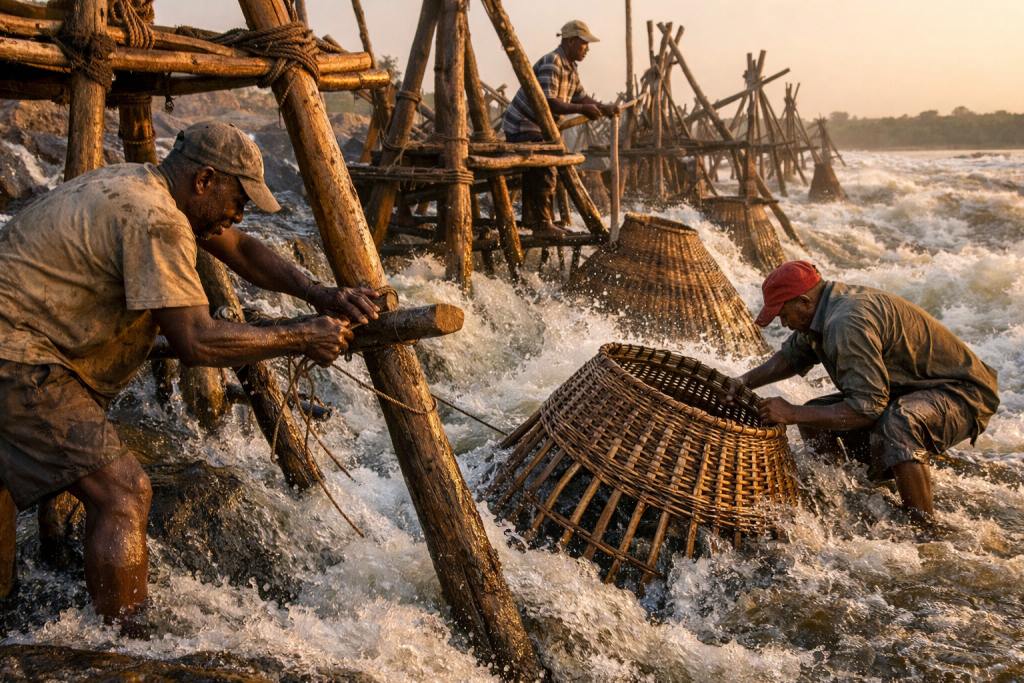
Viewing the falls from designated points along the riverbank is the primary activity for visitors to Boyoma Falls Congo. The seventh cataract, being the widest at 800 yards, offers the most expansive views of the waterfall system.
Observing Wagenia fishing operations provides insight into traditional fishing methods that have been practiced for centuries. Visitors can watch fishermen maintaining the wooden tripod structures and collecting fish from the conical baskets suspended in the rapids.
Photography opportunities at Boyoma Falls include wide-angle shots of the cataracts, close-up images of the fishing structures, and landscape views of the Lualaba River. The best light for photography is typically in the early morning or late afternoon when the sun is lower in the sky.
Boat trips on calmer sections of the river between cataracts can be arranged through local operators in Kisangani. These trips provide a different perspective of the falls system and allow closer observation of the river’s power and the surrounding rainforest.
Cultural visits to Wagenia communities near the falls can be organized with local guides. These visits may include demonstrations of basket weaving techniques, explanations of fishing methods, and opportunities to learn about the cultural significance of the falls to local people.
Birding opportunities exist along the riverbanks and in the surrounding rainforest. The Congo Basin is home to numerous bird species, including kingfishers, herons, and various forest species. Visitors interested in birding should bring binoculars and field guides specific to Central African species.
Boyoma Falls Congo Practical Visitor Information
Visitors should carry cash in US dollars or Congolese francs, as ATM availability in Kisangani is limited and card payment systems are not widely used outside major hotels. Small denominations are useful for local purchases and transport.
Guides familiar with the falls and the local area can be arranged through hotels in Kisangani or through local tour operators. A guide is recommended for navigating to specific viewing points and for facilitating interactions with Wagenia fishermen.
Mobile phone coverage in Kisangani is available through local networks, but coverage can be intermittent in more remote areas along the falls. Visitors should not rely on consistent mobile data access outside the city.
Drinking water should be bottled or treated. Tap water in the region is not safe for consumption without purification. Hotels in Kisangani typically provide bottled water, and it is available for purchase in local shops.
Malaria is endemic in the region. Visitors should take antimalarial medication as prescribed by a travel health professional, use insect repellent containing DEET, and sleep under mosquito nets. Long-sleeved clothing and long trousers are recommended, particularly during dawn and dusk when mosquitoes are most active.
Basic medical facilities are available in Kisangani, but serious medical emergencies may require evacuation to Kinshasa or outside the DRC. Travel insurance that includes medical evacuation coverage is strongly recommended.
Boyoma Falls Congo Safety and Security Considerations
The Democratic Republic of Congo has areas with security concerns, and travelers should check current travel advisories from their government before planning a trip. Tshopo Province, where Boyoma Falls is located, has generally been more stable than some other regions of the DRC, but conditions can change.
Visitors should register with their embassy or consulate upon arrival in the DRC. This registration allows embassies to contact travelers in case of emergencies or significant security developments.
Travel after dark should be avoided. Road conditions and limited street lighting make night travel risky, and the risk of crime increases after sunset.
Visitors should keep copies of important documents, including passports, visas, and vaccination certificates, separate from the originals. Digital copies stored in secure cloud storage provide an additional backup.
Hiring a local guide or working with a registered tour operator provides an additional layer of security and local knowledge. Guides can navigate local customs, communicate in local languages, and provide current information about conditions in the area.
Respect for local customs and dress codes is important. Conservative clothing is appropriate, particularly in rural areas and when visiting communities near the falls.
Boyoma Falls Congo Wildlife and Natural Environment
The area surrounding Boyoma Falls Congo is part of the Congo Basin rainforest ecosystem. This region supports high biodiversity, including numerous mammal, bird, reptile, and fish species.
The Lualaba River and the falls system provide habitat for various fish species, many of which are targeted by Wagenia fishermen. The river’s strong currents and oxygenated water support species adapted to fast-flowing conditions.
Birdlife along the river includes kingfishers, African fish eagles, herons, and cormorants. The surrounding rainforest supports forest-dwelling species such as hornbills, turacos, and various sunbird species.
Mammal sightings near the falls are less common, as the area is relatively developed and human activity is concentrated along the river. The broader Congo Basin region supports populations of forest elephants, primates, and other forest mammals, but these are typically found in more remote protected areas away from Kisangani.
Vegetation along the riverbanks includes riparian forest species adapted to periodic flooding. The dense canopy of the Congo Basin rainforest extends to the river’s edge in many areas, creating a continuous forest corridor.
Water quality in the Lualaba River varies. While the river carries significant sediment, particularly during the rainy season, the turbulent flow through the cataracts oxygenates the water and supports aquatic life.
Boyoma Falls Congo Accommodation and Lodging Options
Kisangani offers the primary accommodation options for visitors to Boyoma Falls Congo. Hotels in the city range from basic guesthouses to midrange properties with air conditioning, private bathrooms, and restaurant facilities.
Advance booking is recommended, particularly during peak travel periods. Communication with hotels can be done via phone or email, though response times may vary.
Accommodation directly at the falls is extremely limited. Most visitors stay in Kisangani and make day trips to viewing points along the falls system.
Hotel amenities in Kisangani typically include basic services such as room cleaning, laundry, and meals. Higher-end properties may offer generator backup for power outages, which can occur in the region.
Camping is not a standard option for visitors to Boyoma Falls due to safety considerations and lack of designated camping facilities. Visitors planning extended stays in the region should arrange hotel accommodation in advance.
Boyoma Falls Congo Cultural Significance and Local Communities
Boyoma Falls holds cultural significance for the Wagenia people and other communities living along the Lualaba River. The falls have provided a food source through fishing for generations and are integrated into local cultural identity.
The traditional fishing methods practiced at Boyoma Falls represent specialized knowledge developed over centuries. The construction and positioning of the wooden tripods and baskets require understanding of water flow patterns, fish behavior, and structural engineering adapted to the river’s force.
Local communities near the falls rely on fishing as a primary livelihood. The sale of fish caught at Boyoma Falls contributes to local economies in Kisangani and surrounding villages.
Visitors observing Wagenia fishing operations should respect the working nature of the activity. Fishermen are engaged in their livelihood, not performing for tourists. Photography should be done with permission, and visitors should not interfere with fishing operations or structures.
Cultural exchanges with local communities can provide deeper understanding of the relationship between people and the river. Guides can facilitate these interactions and provide translation between visitors and community members.
The preservation of traditional fishing methods at Boyoma Falls faces pressures from modernization and changing economic conditions. Support for cultural heritage initiatives can help maintain these practices for future generations.
Frequently Asked Questions About Boyoma Falls Congo
How many cataracts make up Boyoma Falls? Boyoma Falls consists of seven cataracts distributed over 100 kilometers along the Lualaba River between Ubundu and Kisangani.
What is the total drop of Boyoma Falls? The total elevation drop across all seven cataracts is approximately 61 meters (200 feet).
How wide is the largest cataract at Boyoma Falls? The seventh cataract, the largest in the system, measures approximately 800 yards (730 meters) in width.
When is the best time to visit Boyoma Falls Congo? The dry season from June to September offers the best conditions for visiting, with lower water levels making the cataracts more visible and travel logistics more reliable.
How do visitors reach Boyoma Falls? Visitors fly to Kisangani from Kinshasa or Goma, then arrange local transport to viewing points along the falls.
What languages are spoken at Boyoma Falls? French and Swahili are the primary languages spoken in Kisangani and the surrounding region.
Can visitors observe Wagenia fishing at Boyoma Falls? Yes, visitors can observe traditional Wagenia fishing operations from viewing points along the riverbank, particularly during the dry season when the wooden structures are more visible.
Is Boyoma Falls navigable by boat? No, the 100-kilometer stretch of rapids and cataracts is not navigable. A railway line connects Kisangani and Ubundu to bypass the falls.
What is the water volume at Boyoma Falls compared to other falls? Boyoma Falls exceeds both Niagara Falls and Iguazu Falls in total annual water discharge, making it one of the highest-volume waterfall systems globally.
Do visitors need a visa to visit Boyoma Falls Congo? Yes, most nationalities require a visa to enter the Democratic Republic of Congo. Yellow fever vaccination is mandatory and proof must be presented at immigration.
Where does the Lualaba River become the Congo River? The Lualaba River transitions into the Congo River at Boyoma Falls.
Are there accommodation options at Boyoma Falls? Accommodation is primarily available in Kisangani, with limited options directly at the falls. Most visitors stay in the city and make day trips to viewing points.
Key Takeaways About Boyoma Falls Congo Travel
Boyoma Falls is a 100-kilometer waterfall system on the Lualaba River in northeastern DRC, consisting of seven cataracts with a total drop of 61 meters. The falls carry more water volume annually than Niagara or Iguazu Falls, making it one of the most powerful waterfall systems in the world.
Access to Boyoma Falls requires flying to Kisangani from Kinshasa or Goma, then arranging local transport to viewing points. The dry season from June to September provides the best visiting conditions with lower water levels and improved visibility of individual cataracts.
The Wagenia people practice traditional fishing at Boyoma Falls using wooden tripods and conical baskets suspended in the rapids. This centuries-old method represents cultural heritage and provides livelihood for local communities.
Visitors should obtain a DRC visa in advance, carry proof of yellow fever vaccination, and take antimalarial medication. French or Swahili language skills are useful for communication with guides and local operators.
Accommodation is available in Kisangani, with options ranging from basic guesthouses to midrange hotels. Day trips to the falls can be arranged through local guides or tour operators based in the city.
The falls mark the geographic point where the Lualaba River becomes the Congo River, Africa’s second-longest river. A railway line connects Kisangani and Ubundu, circumventing the non-navigable section of the river.
Photography opportunities include wide-angle views of cataracts, close-up shots of fishing structures, and landscape images of the river and surrounding rainforest. Early morning and late afternoon provide the best light conditions.
Travel insurance with medical evacuation coverage is strongly recommended. Basic medical facilities exist in Kisangani, but serious emergencies may require evacuation to Kinshasa or outside the DRC.
Cash in US dollars or Congolese francs is necessary, as ATM availability is limited and card payments are not widely accepted outside major hotels. Small denominations are useful for local purchases and transport.
Respect for local customs, working fishing operations, and cultural heritage practices is important. Visitors should seek permission before photographing fishermen and avoid interfering with fishing structures or operations.