Mount Nyamuragira Congo Volcano Tours and Travel Information
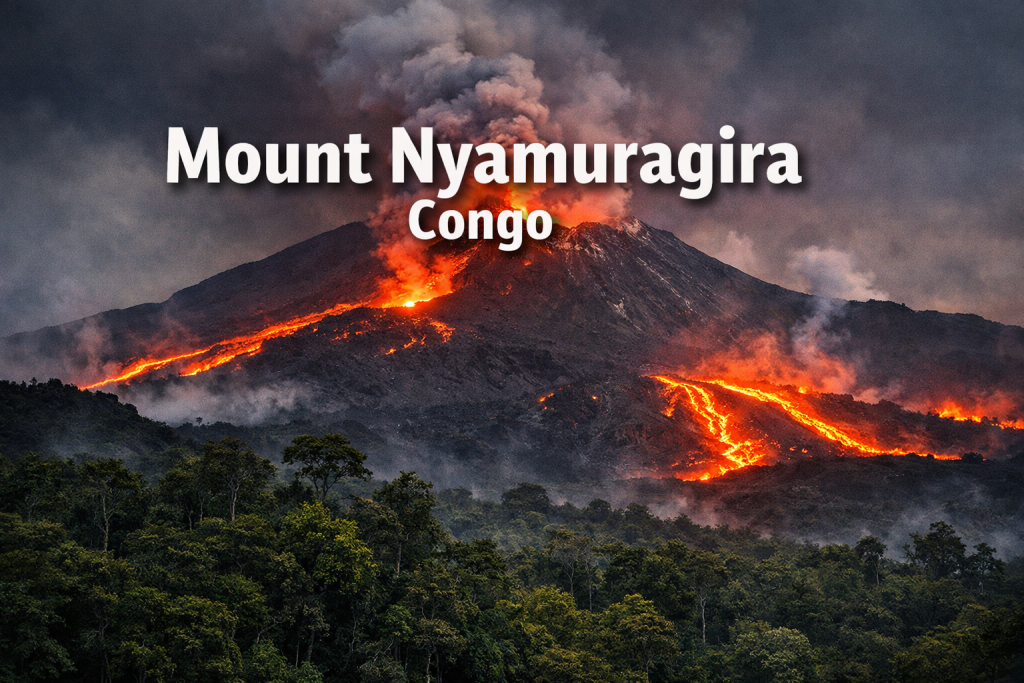
Mount Nyamuragira Congo is an active shield volcano located in Virunga National Park in the Democratic Republic of the Congo, standing at 3,058 meters elevation approximately 25 kilometers north of Lake Kivu. The volcano has been in continuous eruption since April 2018, with persistent lava flows, summit crater activity, and a lava lake that has existed since at least 1921. Visitors planning travel to this region need to understand the volcano’s ongoing activity, access restrictions within Virunga National Park, safety protocols, and the limited tourism infrastructure available for volcano observation tours.
Mount Nyamuragira Congo is Africa’s most active volcano with continuous eruptions since 2018. Lava flows extend up to 8 km from the crater rim as of 2026. The volcano sits within Virunga National Park in eastern DRC. Tourism access is restricted and requires park permits, registered guides, and adherence to safety zones. Viewing is typically conducted from designated observation points, not summit trekking. Best visited during dry seasons from June to September and December to February.
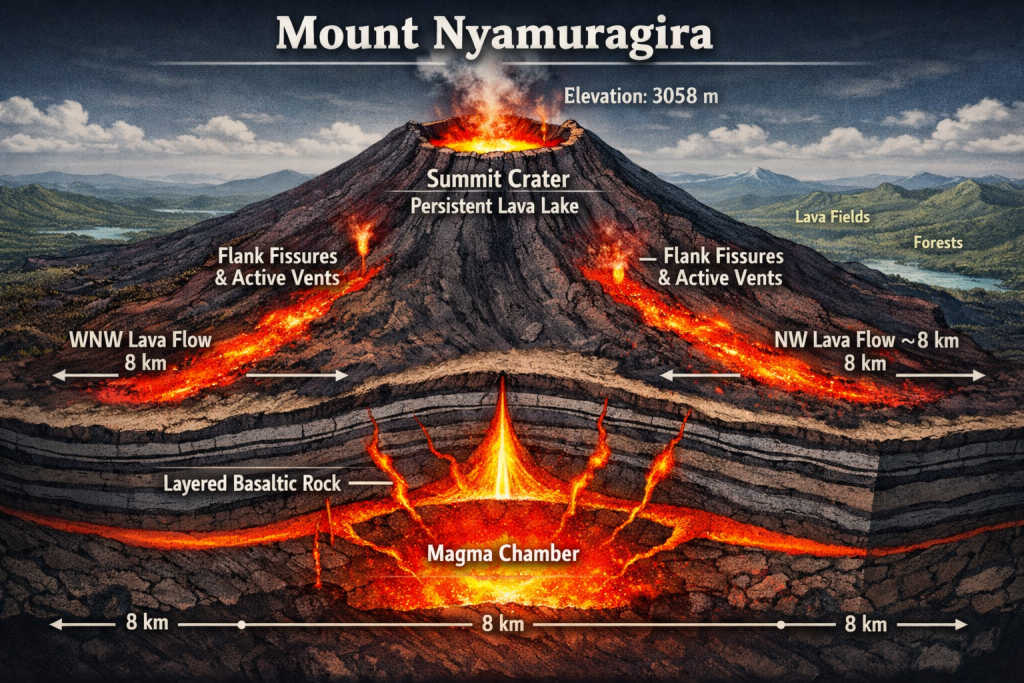
Mount Nyamuragira Congo is a continuously active shield volcano in Virunga National Park, Democratic Republic of the Congo, with ongoing lava flows and summit crater activity monitored by Observatoire Volcanologique de Goma. Tourism to the area is limited, requires coordination with park authorities, and involves viewing the volcano from safe distances rather than summit access. All visits must be arranged through licensed operators familiar with current volcanic activity levels and park access regulations.
Mount Nyamuragira Congo Location and Geography
Mount Nyamuragira Congo sits in the western branch of the East African Rift system within North Kivu Province of the Democratic Republic of the Congo. The volcano is positioned approximately 25 kilometers north of Lake Kivu and 13 kilometers northwest of Mount Nyiragongo, another active volcano in the Virunga volcanic chain.
The summit reaches 3,058 meters above sea level with a large caldera measuring approximately 2 kilometers in diameter. The volcano’s footprint covers extensive terrain, with historical lava flows spanning more than 1,500 square kilometers of the surrounding landscape. This makes it one of the most voluminous volcanic systems in the region.
Access to Mount Nyamuragira Congo requires entry through Virunga National Park gates, with the nearest approach points located near Goma, the provincial capital of North Kivu. Road conditions vary significantly by season, with 4×4 vehicles required for all access routes into the volcanic zone.
Mount Nyamuragira Congo Volcanic Activity Status 2026
Mount Nyamuragira Congo entered its current eruptive phase in April 2018 and has maintained continuous activity through 2026. The Observatoire Volcanologique de Goma monitors the volcano using ground-based seismic networks, satellite thermal imaging from Copernicus and NASA MIROVA systems, and visual observation reports.
As of January 2026, active lava flows were documented on the WNW and NW flanks of the volcano, with the farthest flow extending approximately 8 kilometers from the crater rim. Incandescence from the summit crater and active vents remains visible in satellite imagery, indicating ongoing magma movement and surface eruption.
The summit crater contains a persistent lava lake that has existed continuously since at least 1921, with only one documented drainage event during a major flank eruption in 1938.This lava lake produces thermal anomalies detectable from space and contributes to the volcano’s classification as one of Africa’s most persistently active volcanic systems.
Lava flows from Mount Nyamuragira Congo originate from both the summit crater and numerous flank fissures. Multiple cones have formed along these fissure systems, creating a complex eruption pattern that can shift activity zones over weeks or months. Visitors planning travel need current activity reports from monitoring agencies before finalizing itineraries.
Virunga National Park Access for Mount Nyamuragira Congo Tours
All tourism access to Mount Nyamuragira Congo occurs within Virunga National Park boundaries, requiring coordination with park authorities based in Goma. The park operates under strict conservation and safety protocols that limit visitor movement in active volcanic zones.
Permits for volcano observation tours must be obtained through Virunga National Park’s official booking system or through registered tour operators holding valid park concessions. Independent travel to the volcano without park authorization is prohibited and carries legal consequences under DRC national park regulations.
Current security conditions in North Kivu Province affect park access on a rolling basis. Virunga National Park publishes security updates and sector closures through official channels. Visitors should verify park sector status within 48 hours of planned travel, as conditions can change rapidly based on regional security assessments.
Park entry fees for Virunga National Park vary by activity type and visitor residency status. Foreign visitors typically pay higher rates than DRC nationals or East African Community residents. Fees are separate from guide costs, vehicle hire, and specialized volcano observation permits.
Mount Nyamuragira Congo Viewing Options and Tour Types
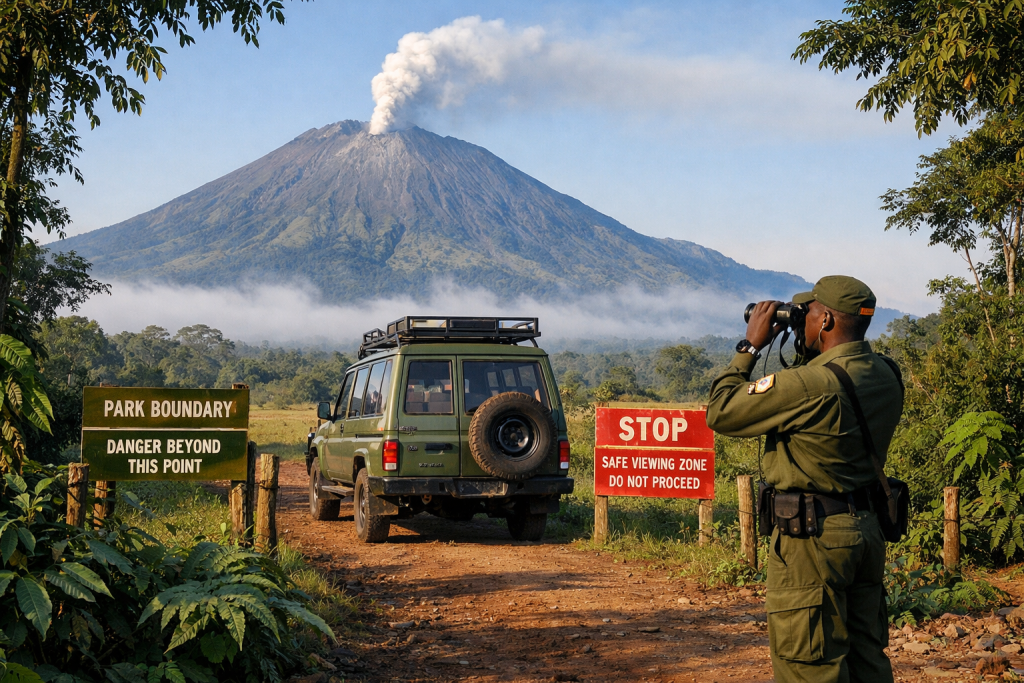
Tourism to Mount Nyamuragira Congo focuses on observation from designated safe zones rather than summit trekking. The ongoing eruption status and active lava flows make close approach or summit access unsafe and unauthorized by park management.
Viewing tours typically operate from established observation points located at safe distances from active flow zones. These points are selected based on current lava flow direction, wind patterns affecting gas dispersal, and terrain accessibility for vehicles or foot access.
Day tours from Goma to Mount Nyamuragira Congo observation points require full-day commitment, with departure times typically before dawn to maximize viewing conditions and allow return before nightfall. Total tour duration ranges from 10 to 14 hours depending on road conditions and observation point distance.
Night viewing tours offer visibility of incandescent lava flows and crater glow not visible during daylight hours. These tours require additional safety protocols, specialized guide training, and may be subject to cancellation based on volcanic activity intensity or weather conditions reducing visibility.
Photography tours to Mount Nyamuragira Congo cater to visitors seeking extended time at observation points for long-exposure night photography or time-lapse documentation of lava flow movement. These tours may include camping at authorized sites within Virunga National Park, subject to current park camping regulations and security clearances.
Mount Nyamuragira Congo Safety Protocols and Visitor Regulations
Safety protocols for Mount Nyamuragira Congo tours are determined by Observatoire Volcanologique de Goma in coordination with Virunga National Park rangers. These protocols change based on current eruption intensity, lava flow advancement rates, and seismic activity levels.
Minimum safe distances from active lava flows are established by park authorities and enforced by guides. Visitors attempting to approach beyond designated boundaries face immediate tour termination and potential park access bans.
Volcanic gas emissions from Mount Nyamuragira Congo include sulfur dioxide and carbon dioxide, which can accumulate in low-lying areas or concentrate based on wind direction. Visitors with respiratory conditions should consult medical professionals before booking volcano observation tours.
All tours to Mount Nyamuragira Congo must be accompanied by armed park rangers in addition to specialized volcano guides. Ranger presence is mandatory due to regional security conditions and wildlife protection protocols within Virunga National Park.
Communication equipment carried by guides includes satellite phones or radio systems for contact with park headquarters and emergency response teams. Mobile phone coverage is absent in most volcanic zone areas, making guide communication systems the only reliable emergency contact method.
Best Time to Visit Mount Nyamuragira Congo
Dry season months from June through September and December through February offer the most reliable road access to Mount Nyamuragira Congo observation points. Wet season conditions from March to May and October to November create road challenges that can make vehicle access impossible or require significantly longer travel times.
Visibility conditions for volcano viewing improve during dry season months when cloud cover and atmospheric moisture are reduced. Clear nights during these periods provide optimal conditions for observing incandescent lava flows and crater glow.
Rainy season visits to Mount Nyamuragira Congo face higher cancellation probability due to road conditions, reduced visibility from cloud cover, and increased difficulty in maintaining safe observation positions on potentially muddy or unstable terrain.
Temperature conditions at observation points near Mount Nyamuragira Congo range from cool to cold, particularly during night viewing tours. Elevations between 2,000 and 2,500 meters where observation typically occurs can experience temperatures dropping to 10-15 degrees Celsius after sunset, requiring warm layered clothing.
Mount Nyamuragira Congo Tour Logistics and Planning
Tour operators offering Mount Nyamuragira Congo visits operate primarily from Goma, with some itineraries originating from Gisenyi, Rwanda, located directly across the border. Cross-border coordination adds complexity to planning and requires valid visa documentation for DRC entry.
Vehicle requirements for Mount Nyamuragira Congo access include 4×4 capability with high ground clearance. Standard safari vehicles or passenger cars cannot navigate the volcanic terrain and degraded road surfaces leading to observation areas.
Guide qualifications for Mount Nyamuragira Congo tours should include specific training in volcanic hazard recognition, current certification from Virunga National Park, and demonstrated experience with active volcano observation protocols. Visitors should verify guide credentials before tour commencement.
Group size limits for volcano observation tours vary by operator and current park regulations. Smaller groups of 4 to 6 visitors typically allow more flexibility in observation point selection and reduce environmental impact on sensitive volcanic terrain.
Accommodation near Mount Nyamuragira Congo is limited to Goma town or lodges within other sectors of Virunga National Park. No permanent accommodation exists in the immediate volcanic zone. Multi-day itineraries may include camping at authorized sites, subject to current park camping availability and security clearances.
Mount Nyamuragira Congo Historical Eruption Context
Mount Nyamuragira Congo has produced more than 40 documented eruptions since 1865, making it Africa’s most frequently active volcano. The volcano’s eruption style typically involves effusive lava flows rather than explosive activity, though ash emissions and lava fountaining occur during intense phases.
Historical lava flows from Mount Nyamuragira Congo have extended more than 30 kilometers from the summit, reaching as far as Lake Kivu in some eruption events. The 1938 eruption produced flows that drained the summit lava lake and created extensive new lava fields across the western flank.
Recent eruption history includes major events in 2001, 2002, 2006, 2010, and 2011-2012 before the current eruptive phase beginning in 2018.Each eruption has contributed to the extensive lava coverage characterizing the landscape surrounding the volcano.
The current eruption phase starting in April 2018 represents one of the longer continuous eruptive periods in the volcano’s documented history. Lava effusion rates have varied throughout this period, with phases of increased activity producing rapid lava flow advancement and periods of lower activity maintaining steady but slower flow progression.
Mount Nyamuragira Congo Wildlife and Ecosystem Impact
Virunga National Park surrounding Mount Nyamuragira Congo contains diverse ecosystems ranging from montane rainforest at lower elevations to alpine vegetation zones at higher altitudes. Active lava flows periodically burn forest areas, creating cycles of destruction and ecological succession.
The January 2026 eruption affected non-populated forest regions within Virunga National Park, burning vegetation but avoiding human settlements. Wildlife in affected zones includes forest elephants, primates, and numerous bird species that relocate during active eruption phases.
Smoke plumes from Mount Nyamuragira Congo can affect air quality across wider regions of Virunga National Park, particularly when combined with emissions from nearby Mount Nyiragongo. These plumes create haze conditions that reduce visibility and can affect wildlife behavior patterns.
Long-term ecosystem recovery in lava-affected zones follows predictable succession patterns, with pioneer plant species colonizing cooled lava fields within years of flow emplacement. Full forest recovery can take decades to centuries depending on lava flow thickness and surrounding seed source availability.
Mount Nyamuragira Congo Photography Considerations
Photography at Mount Nyamuragira Congo observation points requires specific equipment suited to low-light conditions and long-distance subjects. Telephoto lenses in the 200-400mm range allow capture of lava flow details and crater activity from safe observation distances.
Tripod use is necessary for night photography of incandescent lava flows, requiring stable positioning on uneven volcanic terrain. Carbon fiber tripods offer advantages in weight for the hiking often required to reach observation points.
Camera settings for lava flow photography typically involve long exposures ranging from 1 to 30 seconds, low ISO settings to minimize noise, and apertures between f/8 and f/16 for depth of field. Exact settings vary based on lava brightness, ambient light conditions, and desired creative effect.
Volcanic gas and fine ash particles can damage camera equipment if not properly protected. Weather-sealed camera bodies and lenses offer better protection, while regular cleaning of equipment during and after tours prevents buildup of corrosive volcanic particles.
Drone use near Mount Nyamuragira Congo is subject to Virunga National Park regulations and DRC aviation law. Unauthorized drone flights are prohibited and can result in equipment confiscation and legal penalties. Operators seeking aerial photography must obtain specific permits from multiple authorities before flight operations.
Mount Nyamuragira Congo Combination Itineraries
Multi-day itineraries in Virunga National Park often combine Mount Nyamuragira Congo observation with other park activities including mountain gorilla trekking, Mount Nyiragongo crater rim overnight tours, and chimpanzee tracking in the Tongo forest sector.
Mount Nyiragongo, located 13 kilometers southeast of Mount Nyamuragira Congo, offers a contrasting volcanic experience with an accessible summit crater containing one of the world’s largest lava lakes. The Nyiragongo trek involves overnight camping on the crater rim at 3,470 meters elevation, requiring moderate to high fitness levels.
Gorilla trekking permits in Virunga National Park provide access to habituated mountain gorilla families in sectors separate from the volcanic zone. These treks operate year-round, subject to security conditions, and require advance permit booking often months before travel dates.
Combined itineraries require careful scheduling to account for permit availability, physical recovery time between strenuous activities, and potential weather or security disruptions affecting specific park sectors. Tour operators specializing in Virunga National Park multi-activity packages handle complex logistics and permit coordination.
Mount Nyamuragira Congo Travel Requirements and Documentation
Entry to the Democratic Republic of the Congo requires a valid passport with minimum six months validity beyond intended departure date. Visa requirements vary by nationality, with most visitors requiring advance visa application through DRC embassies or consulates.
Virunga National Park permits are separate from DRC visa requirements and must be arranged through park booking systems or registered tour operators. Permit confirmation should be obtained in writing before travel, as verbal confirmations are insufficient for park entry.
Vaccination requirements for DRC travel include yellow fever immunization, which is mandatory and subject to verification at entry points. Additional recommended vaccinations include hepatitis A and B, typhoid, and routine immunizations. Malaria prophylaxis is recommended for all visitors to the Virunga region.
Travel insurance covering emergency medical evacuation is strongly recommended for all visitors to Mount Nyamuragira Congo and Virunga National Park. Standard travel insurance policies may exclude coverage in active conflict zones, requiring specialized policies that explicitly cover DRC travel.
Mount Nyamuragira Congo Cost Factors and Budget Planning
Virunga National Park entry fees for foreign visitors range from 200 to 400 USD per person depending on activity type and duration. Volcano observation tours typically fall in the mid-range of this fee structure.
Guide costs for Mount Nyamuragira Congo tours are separate from park fees, ranging from 100 to 200 USD per day for specialized volcano guides with appropriate training and certification. Armed ranger fees add 50 to 100 USD per day to total costs.
Vehicle hire for 4×4 transport to observation points costs between 150 and 300 USD per day depending on vehicle type, fuel requirements, and distance traveled. Shared vehicle costs among group members reduce per-person expenses.
Accommodation in Goma ranges from budget guesthouses at 30 to 50 USD per night to mid-range hotels at 80 to 150 USD per night. Luxury options are limited, with most higher-end accommodation located within Virunga National Park lodges in other sectors.
Total budget for a Mount Nyamuragira Congo observation tour typically ranges from 400 to 800 USD per person for a day tour from Goma, including park fees, guide costs, vehicle hire, and ranger fees. Multi-day itineraries combining other Virunga activities increase total costs proportionally.
Frequently Asked Questions About Mount Nyamuragira Congo
Can visitors climb to the summit of Mount Nyamuragira Congo?
Summit access to Mount Nyamuragira Congo is not permitted during the current eruption phase that began in 2018. Active lava flows, summit crater activity, and safety protocols established by Virunga National Park restrict visitor access to designated observation points at safe distances from active zones.
How close can visitors get to the lava flows at Mount Nyamuragira Congo?
Minimum safe distances are determined by Observatoire Volcanologique de Goma and enforced by park rangers, typically maintaining observation points at least 1 to 2 kilometers from active flow fronts. Exact distances vary based on current flow activity, gas emissions, and terrain conditions.
Is it safe to visit Mount Nyamuragira Congo with the ongoing eruption?
Visits conducted through registered operators following park safety protocols are considered safe when adhering to established observation distances and guide instructions. The volcano’s effusive eruption style produces predictable lava flows rather than explosive activity, allowing safe observation from appropriate distances.
What is the difference between Mount Nyamuragira and Mount Nyiragongo?
Mount Nyamuragira Congo is a shield volcano with a broad profile and extensive lava flow fields, while Mount Nyiragongo is a stratovolcano with steeper slopes and a large summit lava lake accessible via guided overnight treks. Nyamuragira stands at 3,058 meters compared to Nyiragongo’s 3,470 meters.
When will Mount Nyamuragira Congo stop erupting?
Eruption duration cannot be predicted with certainty. The current eruptive phase has continued since April 2018 with no clear indicators of imminent cessation. Historical eruptions have lasted from weeks to years, with the volcano’s persistent lava lake suggesting long-term magma supply.
Do I need a guide to visit Mount Nyamuragira Congo?
Guides are mandatory for all visits to Mount Nyamuragira Congo within Virunga National Park. Independent access without authorized guides and armed rangers is prohibited under park regulations and poses serious safety and legal risks.
What should I pack for a Mount Nyamuragira Congo tour?
Required items include warm layered clothing for cool temperatures at elevation, sturdy hiking boots with ankle support, headlamp with spare batteries for night viewing, camera equipment with tripod, water bottles carrying at least 2 liters, sun protection, and personal medications. Operators provide specific packing lists based on tour type.
Can I visit Mount Nyamuragira Congo from Rwanda?
Tours can be arranged from Gisenyi, Rwanda, located on the border with Goma. This requires valid DRC visa documentation and coordination with operators handling cross-border logistics. Most visitors find Goma-based operators offer simpler logistics without border crossing complications.
How long does a Mount Nyamuragira Congo tour take?
Day tours from Goma typically require 10 to 14 hours total, including 3 to 5 hours driving each direction and 2 to 4 hours at observation points. Night viewing tours may extend duration to allow optimal darkness conditions for lava observation.
What are the age restrictions for Mount Nyamuragira Congo tours?
Virunga National Park does not impose specific age minimums for volcano observation tours, but operators typically recommend minimum ages of 12 to 15 years based on physical requirements and safety considerations. Maximum age limits are not enforced, though fitness levels must be sufficient for required walking and terrain navigation.
Is mobile phone coverage available near Mount Nyamuragira Congo?
Mobile phone coverage is absent in volcanic zone areas. Guides carry satellite phones or radio communication equipment for emergency contact with park headquarters. Visitors should not rely on personal mobile devices for communication or navigation.
What wildlife might be seen during Mount Nyamuragira Congo tours?
Wildlife sightings are incidental rather than primary tour objectives. Possible species include forest elephants, buffalo, various antelope species, and numerous bird species. Active volcanic zones have reduced wildlife density compared to other park sectors.
Key Takeaways for Mount Nyamuragira Congo Travel
Mount Nyamuragira Congo is Africa’s most active volcano with continuous eruptions documented since April 2018 and ongoing activity through 2026. The volcano sits within Virunga National Park in the Democratic Republic of the Congo at 3,058 meters elevation, approximately 25 kilometers north of Lake Kivu.
Tourism access focuses on observation from designated safe zones rather than summit trekking, with all visits requiring Virunga National Park permits, registered guides, and armed ranger accompaniment. Current lava flows extend up to 8 kilometers from the crater rim on the WNW and NW flanks as of January 2026.
Dry season months from June to September and December to February offer optimal conditions for road access and visibility. Tours typically operate as full-day excursions from Goma requiring 10 to 14 hours total duration.
Safety protocols are established by Observatoire Volcanologique de Goma and enforced by park authorities, with minimum safe distances maintained from active lava flows and crater zones. Volcanic gas emissions and regional security conditions require careful planning and current information verification before travel.
Budget planning should account for park fees, guide costs, vehicle hire, and ranger fees totaling 400 to 800 USD per person for day tours. Multi-day itineraries combining other Virunga National Park activities increase costs but offer comprehensive volcanic and wildlife experiences.
The volcano’s persistent lava lake, active since at least 1921, and extensive historical lava flow coverage spanning more than 1,500 square kilometers make Mount Nyamuragira Congo a significant geological feature with limited but specialized tourism opportunities for visitors prepared for the logistical and safety requirements involved.
Conclusion
Mount Nyamuragira Congo offers specialized volcano observation tourism within one of Africa’s most active volcanic systems. Visitors planning travel to this region need realistic expectations about access limitations, mandatory guide requirements, and the focus on safe-distance observation rather than close approach or summit trekking.
Current eruption activity provides opportunities to observe active lava flows and crater incandescence not available at dormant volcanoes, but requires coordination with monitoring agencies and park authorities to maintain safe viewing protocols. Tour planning should incorporate flexibility for activity-based cancellations or itinerary modifications based on current volcanic conditions.
The combination of ongoing volcanic activity, location within Virunga National Park’s diverse ecosystems, and proximity to other major attractions including Mount Nyiragongo and mountain gorilla habitats creates opportunities for comprehensive itineraries focused on geological and wildlife conservation tourism. Proper preparation, documentation, and operator selection determine success in accessing this remote and actively changing volcanic landscape.