Okapi Wildlife Reserve Dr Congo Safaris and Conservation Tours
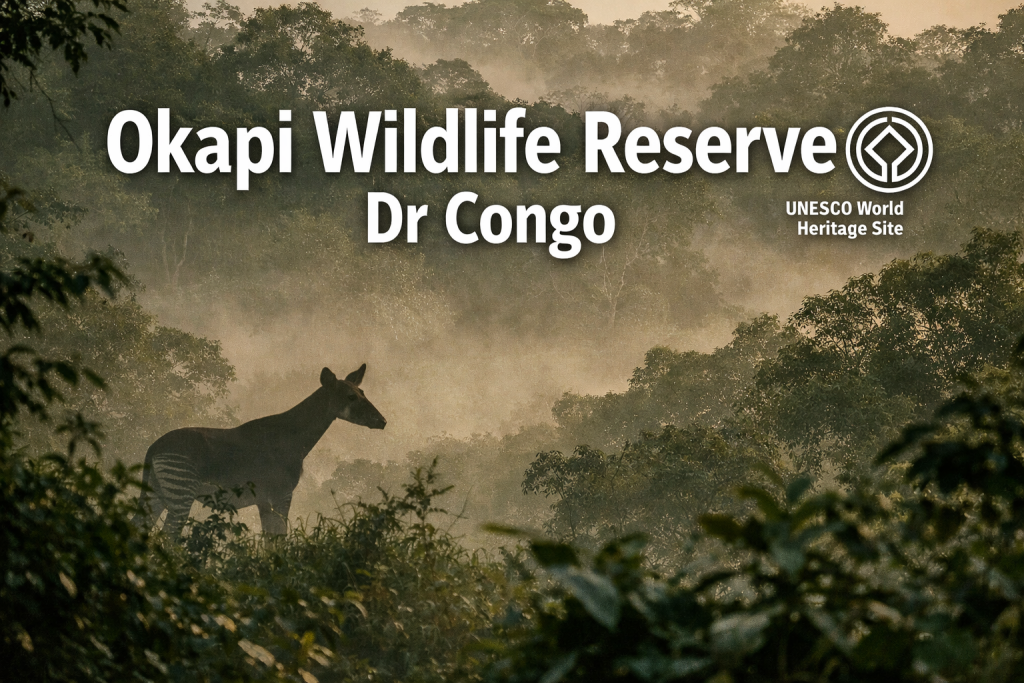
The Okapi Wildlife Reserve Dr Congo is a UNESCO World Heritage Site covering 13,700 square kilometers in the Ituri Forest of north-eastern Democratic Republic of the Congo. This protected area safeguards the largest remaining population of wild okapis, an endangered forest giraffe relative found nowhere else on Earth. The reserve supports between 4,500 to 5,000 okapis alongside forest elephants, 13 primate species, and over 370 bird species across dense equatorial rainforest terrain.
Visitors planning Okapi Wildlife Reserve safaris should understand these core facts before booking travel to this remote Congo conservation area.
The reserve operates under strict management by the Congolese Institute for Nature Conservation (ICCN) with support from international conservation partners. Access requires advance coordination through registered tour operators familiar with security protocols and permit requirements. Wildlife viewing differs significantly from savannah safari experiences due to dense forest cover and solitary okapi behavior patterns.
Seasonal rainfall affects road conditions and accessibility throughout the year. The reserve faces ongoing security concerns from armed group activity in surrounding areas, making professional guided travel mandatory. Conservation fees contribute directly to ranger operations and community programs supporting Indigenous Mbuti and Efe populations living in and around the protected area.
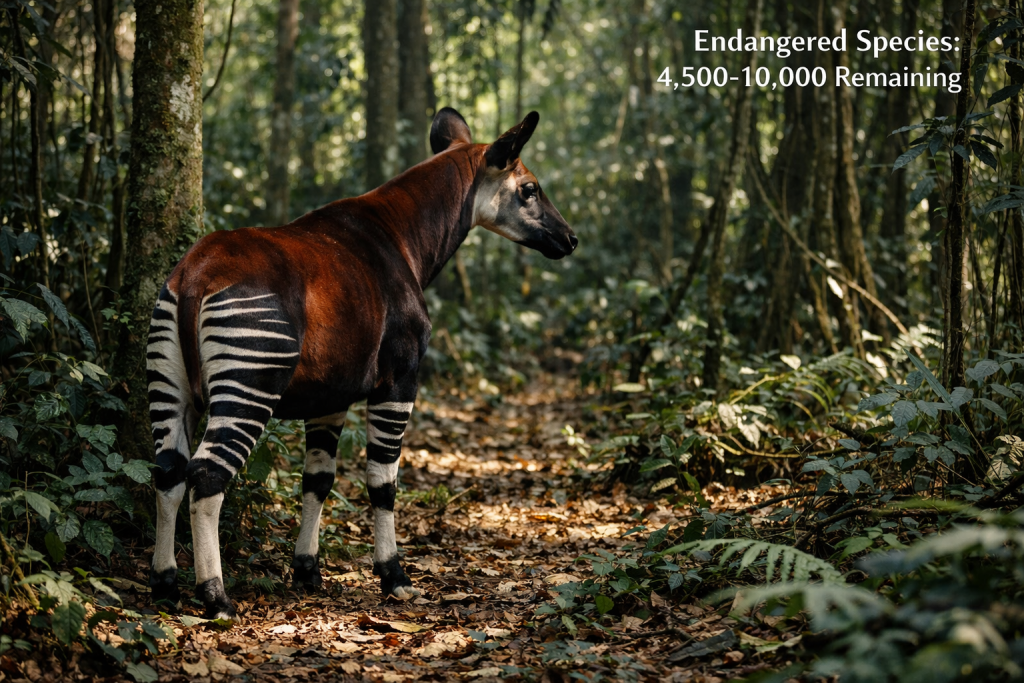
The Okapi Wildlife Reserve Dr Congo functions as a managed conservation area protecting the world’s only viable okapi population in their natural rainforest habitat. Visitors access the reserve through Epulu Station, the main headquarters located approximately 350 kilometers from Kisangani. Travel requires 4×4 vehicles, armed ranger escorts, and permits obtained through tour operators working with ICCN authorities.
Wildlife viewing focuses on forest walks, ranger-led tracking, and visits to the okapi rehabilitation facility at Epulu. The reserve does not offer traditional game drives due to terrain and vegetation density. Most visitors spend 2 to 3 days in the area, combining okapi viewing with cultural visits to Mbuti communities and forest birding activities.
Location and Geography of Okapi Wildlife Reserve Dr Congo
The Okapi Wildlife Reserve occupies nearly one-fifth of the Ituri Forest in Tshopo Province, north-eastern Democratic Republic of the Congo. The reserve boundaries extend across 13,700 square kilometers of equatorial rainforest at elevations ranging from 500 to 1,000 meters above sea level.
The Ituri Forest forms part of the greater Congo Basin rainforest system, the second-largest tropical forest block globally. The reserve sits approximately 350 kilometers north-east of Kisangani, the nearest major city with airport facilities. Road access from Kisangani requires 8 to 12 hours of travel depending on seasonal conditions and road maintenance status.
The Epulu River runs through the reserve, with Epulu Station positioned along its banks serving as the primary visitor entry point and ranger headquarters. The reserve borders several community forests where Indigenous populations maintain traditional land use rights. Terrain consists of flat to gently rolling lowland forest with numerous small streams feeding into the Epulu and Ituri river systems.
Wildlife Species in Okapi Wildlife Reserve Dr Congo
The reserve protects approximately 5,000 okapis, representing the largest concentration of this species anywhere in their remaining range. Okapis occupy solitary territories throughout the forest, with females maintaining larger home ranges than males. These forest giraffids feed on leaves, fruits, and fungi across defined areas that can exceed 10 square kilometers per individual.
Forest elephants move through the reserve in small family groups, though population numbers remain difficult to assess due to dense vegetation and poaching pressure. Thirteen primate species inhabit the reserve including eastern chimpanzees, red colobus monkeys, and several species of guenons and mangabeys. Leopards, golden cats, and other forest carnivores occur at low densities typical of rainforest predator populations.
Bird diversity exceeds 370 recorded species including Congo peacocks, African green broadbills, and numerous forest-specialist species not found in savannah habitats. The reserve supports populations of duikers, forest buffalo, giant forest hogs, and bongo antelope, though sightings remain unpredictable due to animal behavior and habitat structure.
Reptile and amphibian diversity is high but poorly documented. The reserve’s rivers and streams contain various fish species and crocodiles, though visitor access to aquatic habitats remains limited.
Okapi Conservation Status and Protection Efforts
The International Union for Conservation of Nature (IUCN) classifies okapis as Endangered, reflecting documented population declines over the past decade.[1] On November 28, 2025, the Convention on International Trade in Endangered Species (CITES) voted to list okapis on Appendix I, imposing a complete international ban on commercial trade of okapi parts, skins, and live animals.
Current population estimates place global okapi numbers between 4,500 and 10,000 individuals, with the Okapi Wildlife Reserve holding the largest concentration. Smaller populations survive in Maiko National Park, Lomami National Park, and scattered community forests across the Congo Basin.
Female okapis have gestation periods lasting up to 16 months and produce single calves, making population recovery slow even under protected conditions. Okapis reach sexual maturity at 2 to 3 years but may not breed successfully until older. Solitary behavior and large territory requirements mean population densities remain naturally low even in optimal habitat.
The Okapi Conservation Project (OCP), Wildlife Conservation Society (WCS), and ICCN coordinate protection efforts including ranger patrols, anti-poaching operations, and community conservation programs. In February 2025, rangers successfully brought an okapi to Epulu Station for the first time in over 10 years, marking recovery progress following a devastating 2012 armed attack that killed seven people and 14 captive okapis.
Threats Facing Okapi Wildlife Reserve Dr Congo
Habitat loss from illegal logging, artisanal mining, and charcoal production continues to fragment okapi habitat both within and surrounding the reserve. A Chinese-run gold mining operation has expanded within reserve boundaries despite protections established three decades ago, accelerating forest degradation and increasing poaching access.
Poaching for bushmeat and okapi skins persists despite patrol efforts. Okapi meat and skins hold cultural value in some communities, while commercial bushmeat trade supplies regional markets. Snares set for duikers and other small antelope also capture okapis, causing injury or death.
Armed group presence throughout the Ituri Forest creates security risks for rangers and limits patrol effectiveness. The Allied Democratic Forces (ADF), a Ugandan Islamist armed group, operates in parts of the reserve alongside other militia groups controlling territory and resources. Rangers face direct threats during patrols, with several killed in confrontations over the past decade.
Climate variability affects forest productivity and okapi food availability, though long-term climate impacts remain poorly studied. Human population growth in surrounding areas increases pressure for agricultural land, forest resources, and wildlife protein. Limited economic alternatives for local communities maintain dependence on forest extraction despite conservation programs.
Visiting Okapi Wildlife Reserve Dr Congo Safari Tours
Access to the Okapi Wildlife Reserve requires advance coordination through tour operators registered with ICCN and experienced in Congo travel logistics. Independent travel to the reserve is not permitted due to security protocols and permit requirements. Visitors must arrange transport, permits, ranger escorts, and accommodation through licensed operators.
Travel from Kisangani to Epulu takes 8 to 12 hours by 4×4 vehicle on roads that deteriorate significantly during rainy seasons. Road conditions change frequently based on maintenance, rainfall, and vehicle traffic. Some tour operators arrange charter flights to reduce travel time, though landing strips near the reserve have limited capacity and weather restrictions.
Visitors report to Epulu Station upon arrival for permit verification and ranger assignment. All activities within the reserve require armed ranger accompaniment for security and wildlife protection. Rangers familiar with okapi territories lead forest walks to areas where recent signs or sightings have been recorded.
The okapi rehabilitation facility at Epulu Station allows visitors to observe okapis in semi-wild enclosures. This facility houses animals rescued from poaching attempts, orphaned calves, and individuals being monitored for research purposes. Viewing occurs from designated areas with ranger supervision to minimize stress on animals.
Activities and Experiences in Okapi Wildlife Reserve Tours
Forest walks with rangers constitute the primary activity for visitors seeking wild okapi encounters. These walks last 2 to 4 hours and cover 3 to 8 kilometers depending on terrain, okapi sign, and visitor fitness levels. Rangers track fresh feeding signs, footprints, and dung to locate animals, though sightings are never guaranteed due to okapi behavior and forest density.
Visitors to Epulu Station can observe captive and semi-captive okapis in rehabilitation enclosures. Viewing times are scheduled to avoid disturbing animals during feeding and rest periods. Rangers provide information about individual animals, their rescue stories, and okapi biology. Photography is permitted from designated viewing areas with restrictions on flash use and noise.
Cultural visits to Mbuti and Efe communities offer insight into Indigenous forest peoples’ traditional lifestyles and conservation roles. These visits are arranged through community liaisons and follow protocols established by village leadership. Activities may include demonstrations of net hunting techniques, forest plant knowledge, and traditional music, with visits lasting 2 to 3 hours.
Bird watching in the reserve attracts visitors interested in Congo Basin forest species. Ranger guides familiar with bird calls and habitats lead early morning walks targeting species like Congo peacocks, African green broadbills, and various hornbill species. Binoculars and field guides are recommended, as forest canopy height and vegetation density make bird identification challenging.
The Epulu River offers limited opportunities for forest stream observation, though swimming and water activities are not recommended due to current strength and wildlife presence. Some lodges arrange riverside relaxation areas where visitors can observe forest edge wildlife and bird activity.
Best Time to Visit Okapi Wildlife Reserve Dr Congo
The Okapi Wildlife Reserve experiences equatorial climate patterns with rainfall distributed throughout the year. Two relatively drier periods occur from December to February and June to August, though rain can fall during any month. These drier windows offer better road conditions and easier forest walking, making them preferred for safari planning.
The wettest months from March to May and September to November bring heavy rainfall that can make roads impassable and forest trails muddy and difficult. Vehicle access to the reserve may be interrupted during peak rains, requiring extended travel times or alternative routing. Forest walking becomes more physically demanding in wet conditions, though wildlife activity continues year-round.
Okapi behavior does not vary significantly by season, as forest food availability remains relatively stable throughout the year. Breeding and calving occur year-round rather than in distinct seasons, meaning visitors have similar chances of observing different age classes during any month.
Bird activity peaks during certain months based on species-specific breeding cycles, with some migrants present from November to April. Resident forest species remain active year-round but may be more vocal during breeding periods. Primate activity levels stay consistent across seasons, though fruit availability affects ranging patterns for some species.
Visitor numbers remain low throughout the year due to access challenges and security considerations. The reserve does not experience crowding issues, and tour operators can arrange visits during any month based on client schedules and road condition assessments.
Accommodation Options for Okapi Wildlife Reserve Safaris
Accommodation near the Okapi Wildlife Reserve centers on Epulu Station and surrounding areas. Options remain limited compared to more developed safari destinations, with facilities ranging from basic guesthouses to simple tented camps. Advance booking through tour operators is required, as walk-in accommodation is not available.
The Okapi Conservation Project operates a guesthouse at Epulu Station with basic rooms, shared facilities, and meals prepared by local staff. This option provides direct access to the okapi facility and ranger headquarters. Rooms have beds with mosquito nets, limited electricity from generators, and bucket showers. Meals focus on local ingredients including rice, beans, vegetables, and occasional fish or chicken.
Small private camps near Epulu offer tented accommodation with similar amenity levels. These camps provide beds, mosquito protection, and shared washing facilities. Some camps have covered dining areas and basic lounge spaces. Generator power operates for limited hours in the evening. Camp staff prepare meals using provisions brought from Kisangani or purchased from local markets.
Visitors should expect accommodation standards well below typical safari lodge levels. Running water may be limited to certain hours, hot water comes from heated buckets, and electricity is available only during generator operation. Internet and mobile phone coverage is absent or extremely limited. Accommodation focuses on function rather than comfort, suitable for visitors prioritizing conservation access over amenities.
All accommodation options include meals as part of the package, as independent dining facilities do not exist in the area. Dietary restrictions should be communicated to operators during booking to allow for provision planning. Drinking water comes from treated or bottled sources provided by the accommodation.
Health and Safety Considerations for Okapi Reserve Tours
Yellow fever vaccination is mandatory for entry to the Democratic Republic of the Congo, and visitors must carry valid vaccination certificates. Malaria is present throughout the Ituri Forest region, and prophylaxis medication is required. Visitors should begin malaria prevention medication before arrival and continue as directed by healthcare providers.
Medical facilities near the Okapi Wildlife Reserve are extremely limited. Epulu has a basic health post with minimal supplies and no advanced treatment capabilities. Serious medical issues require evacuation to Kisangani or beyond, a process that can take many hours or days depending on road conditions and available transport. Comprehensive travel insurance including medical evacuation coverage is required by most tour operators.
Security risks from armed group activity require strict adherence to ranger guidance and operator protocols. Visitors must remain with assigned rangers at all times and follow instructions regarding movement, timing, and restricted areas. Some parts of the reserve remain off-limits due to ongoing security concerns. Tour operators monitor security situations continuously and may alter itineraries or cancel trips if conditions deteriorate.
Drinking water must come from treated or bottled sources only. Visitors should carry personal water purification methods as backup. Food safety depends on proper cooking and handling, with higher risks for raw vegetables and unpeeled fruits. Most operators provide meals prepared to minimize health risks, but gastrointestinal issues can still occur.
The forest environment presents physical challenges including uneven terrain, slippery conditions when wet, thorny vegetation, and high humidity. Visitors need reasonable fitness levels for forest walking. Insect bites from mosquitoes, biting flies, and other insects are common despite repellent use. Long sleeves, long pants, and closed shoes are recommended for forest activities.
Permits and Regulations for Okapi Wildlife Reserve Visits
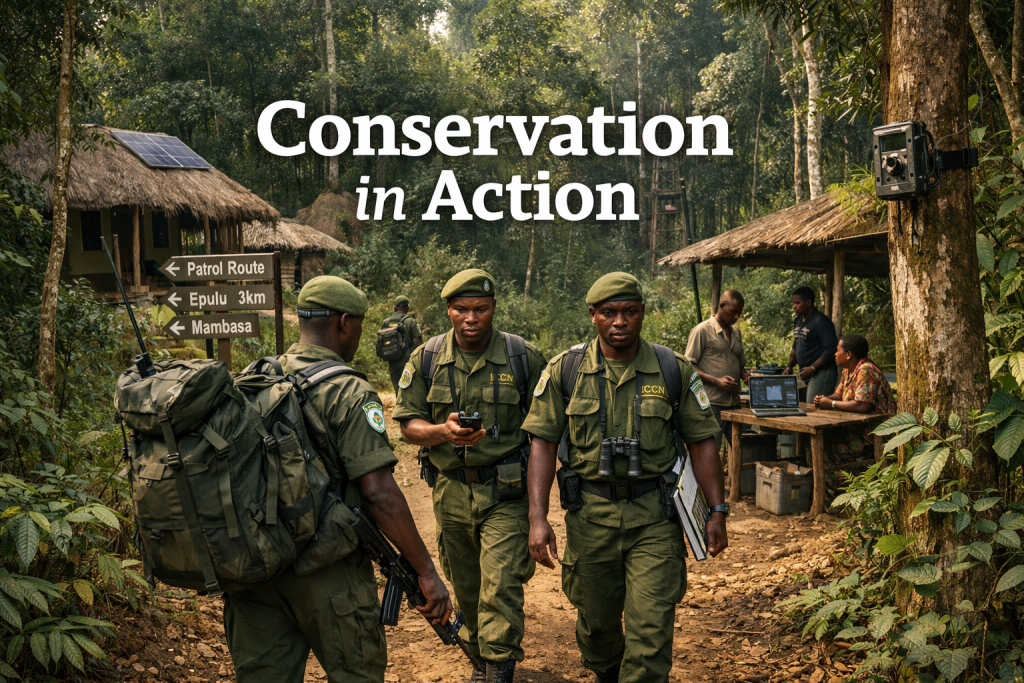
All visitors require permits issued by the Congolese Institute for Nature Conservation (ICCN) to enter the Okapi Wildlife Reserve. Tour operators handle permit applications and fees as part of package arrangements. Individual travelers cannot obtain permits independently. Permit fees contribute to reserve management, ranger salaries, and community conservation programs.
Visitors must present valid passports and Congo visas at reserve entry points. Visa requirements for the Democratic Republic of the Congo vary by nationality, with most visitors requiring visas obtained before arrival. Some nationalities can obtain visas on arrival at major entry points, but this option is not reliable for Okapi Reserve travel. Tour operators provide current visa guidance during trip planning.
Photography permits may be required for professional camera equipment or commercial filming purposes. Personal photography for non-commercial use is generally permitted without additional fees, though rangers may restrict photography in certain situations to protect wildlife or community privacy. Drone use is prohibited without special authorization from ICCN and aviation authorities.
Visitors must follow ranger instructions regarding wildlife viewing distances, noise levels, and movement patterns. Feeding wildlife is strictly prohibited. Littering carries penalties, and visitors must carry out all waste. Smoking is restricted to designated areas away from wildlife and vegetation. Alcohol consumption is generally not permitted during activities.
Cultural visits to Indigenous communities require separate permissions arranged through community liaisons. Visitors must respect photography restrictions in villages, with some communities prohibiting photos entirely and others allowing them only with individual consent and possible fees. Gift-giving to communities should be coordinated through tour operators to ensure appropriate items and distribution.
Getting to Okapi Wildlife Reserve Dr Congo
International travelers reach the Democratic Republic of the Congo through Kinshasa’s N’djili International Airport, the country’s main international gateway. Domestic flights connect Kinshasa to Kisangani, the nearest city to the Okapi Wildlife Reserve with regular air service. Several airlines operate the Kinshasa to Kisangani route, though schedules change frequently and delays are common.
From Kisangani, road travel to Epulu covers approximately 350 kilometers on Route Nationale 4. This journey requires 4×4 vehicles due to road conditions that range from poor to extremely poor depending on maintenance and weather. Tour operators arrange private vehicles with experienced drivers familiar with the route and current conditions.
Some tour operators offer charter flight options from Kisangani to airstrips near Epulu, reducing travel time to under 90 minutes. Charter availability depends on aircraft availability, weather conditions, and airstrip status. Charter costs significantly exceed road transport but may be preferred by visitors with limited time or concerns about road journey difficulty.
Overland travel from Uganda or Rwanda is theoretically possible but involves multiple border crossings, additional permits, and significantly increased security risks. Most tour operators do not recommend or arrange overland approaches from neighboring countries. Visitors should plan routing through Kinshasa and Kisangani for most reliable access.
All transport arrangements should be made through registered tour operators with current knowledge of road conditions, security situations, and permit requirements. Independent travel attempts frequently encounter insurmountable logistical and security obstacles.
Conservation Programs and Community Involvement
The Okapi Conservation Project works with local communities to develop alternatives to forest resource extraction. Agroforestry programs teach sustainable farming techniques that reduce pressure on forest land while improving food security and income. These programs introduce crops compatible with forest edge environments and provide training in soil management and crop rotation.
Community ranger programs employ local residents in patrol and monitoring activities, providing income while building local investment in conservation outcomes. Rangers from Mbuti and Efe communities bring traditional forest knowledge to tracking and wildlife monitoring efforts. Training programs develop skills in GPS use, data collection, and anti-poaching techniques.
Education initiatives in villages surrounding the reserve focus on okapi conservation importance, sustainable resource use, and human-wildlife conflict reduction. School programs reach children with conservation messages while providing educational materials often unavailable in remote areas. Adult education addresses practical topics like crop protection from wildlife and alternative income development.
The Okapi Conservation Project supports health clinics and clean water projects in partner communities, linking conservation support to tangible community benefits. These programs aim to build positive associations between the reserve and improved living conditions. Community members participate in program planning to ensure initiatives address actual needs and priorities.
Research programs within the reserve collect data on okapi populations, distribution, and behavior to inform management decisions. Camera trap surveys, dung count transects, and ranger patrol data contribute to population monitoring. This information helps identify critical habitat areas requiring enhanced protection and tracks conservation intervention effectiveness over time.
Comparing Okapi Wildlife Reserve to Other Congo Safari Destinations
The Okapi Wildlife Reserve differs fundamentally from savannah parks like those in East and Southern Africa. Forest habitat prevents the wide-open wildlife viewing typical of grassland reserves. Animal sightings require patience, forest walking skills, and acceptance that many species will remain hidden despite their presence.
Virunga National Park in eastern Congo offers mountain gorilla trekking as its primary attraction, with more developed tourism infrastructure than the Okapi Reserve. Virunga’s gorilla permits follow similar protocols to Rwanda and Uganda programs, with higher success rates for primate encounters than okapi sightings. Virunga also faces security challenges but has more consistent tourist visitation.
Kahuzi-Biega National Park protects eastern lowland gorillas and offers another primate-focused alternative to okapi tracking. Kahuzi-Biega has better road access from Bukavu and more established accommodation options. The park’s gorilla habituation program provides reliable wildlife encounters compared to the Okapi Reserve’s wild animal tracking approach.
Salonga National Park, Africa’s largest tropical rainforest reserve, remains extremely remote with minimal tourism infrastructure. Salonga protects bonobos and forest elephants but receives fewer than 100 tourists annually due to access difficulties exceeding even the Okapi Reserve’s challenges.
The Okapi Wildlife Reserve suits visitors specifically interested in okapi conservation, forest ecosystems, and remote wilderness experiences. Those seeking reliable wildlife sightings, comfortable accommodation, or traditional safari experiences will find better matches in savannah parks or gorilla trekking destinations.
Photography Considerations for Okapi Wildlife Reserve Tours
Forest photography presents distinct challenges compared to savannah wildlife photography. Low light levels under dense canopy require cameras capable of high ISO performance with minimal noise. Lenses with wide maximum apertures (f/2.8 or wider) perform better than slower telephoto lenses in forest conditions.
Okapi encounters occur at variable distances depending on vegetation density and animal tolerance. A versatile zoom lens covering 70-200mm or 100-400mm provides flexibility for different encounter scenarios. Wider lenses in the 24-70mm range capture forest habitat context and environmental portraits when animals allow closer approach.
Humidity and occasional rain require weather-sealed camera bodies and lenses or protective covers. Silica gel packets help manage moisture in camera bags. Spare batteries are needed as cold and humidity reduce battery life, and charging opportunities may be limited to generator hours at accommodation.
The okapi facility at Epulu Station offers the most predictable photography opportunities with better light conditions than deep forest. Early morning and late afternoon provide the best natural light, though forest shade remains challenging. Flash use is generally prohibited to avoid stressing animals.
Forest bird photography requires fast autofocus, high ISO capability, and patience. Birds move quickly through dense vegetation, and clear shots are brief. Long telephoto lenses (400mm or longer) help isolate birds from cluttered backgrounds, though carrying heavy equipment on forest walks is physically demanding.
Cultural photography in Mbuti and Efe villages requires sensitivity and permission. Some individuals may request payment for photos, while others may decline entirely. Visitors should always ask before photographing people and respect refusals without pressure.
What to Pack for Okapi Wildlife Reserve Safaris
Clothing for the Okapi Wildlife Reserve should prioritize long sleeves and long pants in lightweight, quick-drying fabrics. Colors in neutral tones (greens, browns, khaki) blend with forest environments and avoid attracting insects. At least three changes of clothing allow for daily washing and drying in humid conditions.
Footwear must include waterproof hiking boots with good ankle support and tread for muddy, uneven forest trails. A second pair of closed shoes provides backup if primary boots become saturated. Sandals or lightweight shoes for evening use at accommodation offer relief from boots.
Rain gear including a waterproof jacket and pants is mandatory regardless of travel season. Sudden rain showers occur throughout the year, and forest walking continues in light rain. A waterproof cover for backpacks protects cameras, documents, and other moisture-sensitive items.
Insect repellent containing DEET in concentrations of 30% or higher provides best protection against forest mosquitoes and biting flies. Multiple bottles should be packed as daily reapplication is necessary. A head net offers additional protection during periods of intense insect activity.
A headlamp or flashlight with spare batteries is required for moving around accommodation after dark and for early morning departures. Generator power operates on limited schedules, and ambient light is minimal in forest settings.
Basic first aid supplies including blister treatment, pain relievers, antihistamines, anti-diarrheal medication, and personal prescription medications should be packed. Medical supplies are not available for purchase near the reserve.
Binoculars in the 8×42 or 10×42 range enhance wildlife and bird viewing in forest conditions. Compact models reduce carrying weight during forest walks.
Cost Considerations for Okapi Wildlife Reserve Travel
Tour packages to the Okapi Wildlife Reserve typically range from $2,500 to $5,000 per person for 3 to 5 day itineraries including Kisangani transport, permits, accommodation, meals, and guiding. Costs vary based on group size, accommodation standards, and charter flight inclusion. Private tours cost more than shared group departures.
International flights to Kinshasa and domestic flights to Kisangani add $1,500 to $3,000 depending on origin city and booking timing. Visa fees for the Democratic Republic of the Congo range from $100 to $300 depending on nationality and visa type. Yellow fever vaccination and malaria prophylaxis add $150 to $300 to pre-trip medical costs.
Conservation fees and permits are included in tour package prices but typically represent $200 to $400 of the total cost. These fees go directly to ICCN for reserve management and ranger support. Cultural visit fees to Indigenous communities add $50 to $100 per visit, distributed to village leadership.
Tips for rangers, guides, drivers, and accommodation staff should be budgeted at $20 to $50 per day depending on service quality and group size. Tipping is expected but should be given directly to individuals or through tour operator protocols.
Travel insurance with medical evacuation coverage costs $100 to $300 for a one-week trip depending on age, coverage limits, and provider. This insurance is mandatory for most operators due to limited local medical facilities.
Photography equipment, specialized clothing, and personal items represent additional costs based on individual needs and existing gear. Budget travelers can minimize these costs by borrowing or renting equipment, while photographers may invest significantly in appropriate gear.
Frequently Asked Questions About Okapi Wildlife Reserve Dr Congo
Can visitors see wild okapis during a visit to the reserve?
Wild okapi sightings are possible but not guaranteed during forest walks with rangers. Okapis are solitary, occupy large territories, and remain hidden in dense vegetation. Rangers track fresh signs to improve sighting chances, but forest conditions and animal behavior mean many visitors do not see wild okapis. The okapi facility at Epulu Station provides reliable viewing of captive and semi-captive individuals.
Is it safe to visit the Okapi Wildlife Reserve?
Safety depends on current security conditions, which change based on armed group activity in the region. Reputable tour operators monitor situations continuously and only operate when acceptable security levels exist. Visitors must follow ranger protocols strictly and travel with armed escorts. The reserve has experienced violent incidents in the past, and risks cannot be eliminated entirely.
How physically demanding are forest walks in the reserve?
Forest walks involve 2 to 4 hours of hiking on uneven, often muddy trails with obstacles including roots, fallen trees, and stream crossings. Humidity and heat increase physical effort. Visitors need moderate fitness levels and should be comfortable walking several kilometers in challenging conditions. Pace adjusts to group capabilities, but terrain cannot be modified.
What is the best way to book an Okapi Wildlife Reserve safari?
Booking through specialized tour operators with proven Congo experience provides the most reliable approach. Operators should have established relationships with ICCN, current security knowledge, and logistics capacity for the Kisangani to Epulu route. Booking at least 3 to 6 months in advance allows for permit processing and travel arrangements.
Are there age restrictions for visiting the reserve?
No formal age restrictions exist, but the physical demands of forest walking, basic accommodation conditions, and health risks make the reserve unsuitable for young children and visitors with mobility limitations. Most operators recommend minimum ages of 12 to 15 years and assess individual capabilities during booking.
What languages are spoken by guides and rangers?
French is the primary language for official communication in the reserve. Many rangers and guides speak Swahili and local languages including Kibila and Mbuti dialects. English-speaking guides are available through some tour operators but should be requested during booking. Basic French knowledge helps with communication.
Can visitors interact with Indigenous communities?
Cultural visits to Mbuti and Efe communities are possible through arranged programs with community consent. Interactions follow protocols established by village leadership and focus on cultural demonstrations and information sharing. Visits last 2 to 3 hours and include participation fees distributed to communities.
What other wildlife might visitors see besides okapis?
Forest elephants, multiple primate species including chimpanzees and red colobus monkeys, duikers, forest buffalo, and numerous bird species inhabit the reserve. Sightings vary based on animal behavior, location, and timing. Forest conditions mean wildlife encounters are less frequent and predictable than in savannah habitats.
Is mobile phone or internet access available in the reserve?
Mobile phone coverage is absent throughout most of the reserve including Epulu Station. Some accommodation may have satellite communication for emergencies, but visitor access to internet and phone services is not available. Visitors should plan for complete communication disconnection during their stay.
What is the accommodation standard like?
Accommodation is basic with simple rooms or tents, shared facilities, bucket showers, and limited generator electricity. Standards are well below typical safari lodge levels, focusing on function rather than comfort. Visitors should expect rustic conditions similar to remote camping with minimal amenities.
How does visiting the Okapi Reserve support conservation?
Visitor fees contribute directly to reserve management, ranger salaries, and community programs. Tourism demonstrates economic value for okapi protection, encouraging government and community support for conservation. Small visitor numbers limit tourism impact while providing meaningful financial support to protection efforts.
What vaccinations are required for visiting?
Yellow fever vaccination is mandatory with certificate verification at entry. Malaria prophylaxis is required due to high transmission risk. Routine vaccinations including hepatitis A and B, typhoid, and tetanus are recommended. Visitors should consult travel medicine specialists at least 6 weeks before departure.
Lorem ipsum dolor sit amet, consectetur adipiscing elit. Ut elit tellus, luctus nec ullamcorper mattis, pulvinar dapibus leo.
Key Takeaways
The Okapi Wildlife Reserve Dr Congo protects the world’s largest okapi population across 13,700 square kilometers of Ituri Forest. This UNESCO World Heritage Site offers forest-based wildlife experiences fundamentally different from savannah safari parks.
Access requires professional tour operator arrangements including permits, 4×4 transport from Kisangani, armed ranger escorts, and basic accommodation at Epulu Station. Wild okapi sightings are possible but not guaranteed due to solitary behavior and dense forest habitat. The okapi facility provides reliable viewing of captive individuals.
Security concerns from armed group activity require strict adherence to ranger protocols and continuous situation monitoring by operators. Medical facilities are extremely limited, making comprehensive travel insurance with evacuation coverage mandatory.
The reserve suits visitors specifically interested in okapi conservation, forest ecosystems, remote wilderness, and Indigenous culture. Those seeking comfortable accommodation, reliable wildlife sightings, or traditional safari experiences should consider alternative destinations.
Conservation fees and tourism revenue support ranger operations, anti-poaching efforts, and community programs. Visiting during drier periods from December to February or June to August provides better road conditions and forest walking, though okapi activity continues year-round.
Physical fitness for forest hiking, acceptance of basic amenities, and flexibility regarding wildlife encounters are required for successful visits. The Okapi Wildlife Reserve offers access to one of Africa’s most endangered large mammals in their natural habitat, with experiences focused on conservation rather than comfort.
Conclusion
The Okapi Wildlife Reserve Dr Congo represents a conservation-focused destination requiring realistic expectations about access challenges, accommodation standards, and wildlife viewing probabilities. This protected area serves primarily as a refuge for endangered okapis rather than a developed tourism site, with visitor experiences reflecting that conservation priority.
Planning should begin 3 to 6 months before intended travel dates to allow for permit processing, operator selection, and necessary health preparations. Visitors must work with experienced tour operators familiar with current security conditions, road status, and reserve protocols. Independent travel is not feasible due to permit requirements, access restrictions, and safety considerations.
The reserve offers opportunities to support okapi conservation through tourism revenue while experiencing equatorial rainforest ecosystems and Indigenous cultures. Success depends on accepting forest habitat limitations, basic amenities, and the possibility of not seeing wild okapis despite ranger efforts.
Those who visit the Okapi Wildlife Reserve contribute directly to protection of a species found nowhere else on Earth, in one of Africa’s most threatened forest ecosystems. This contribution comes through a travel experience emphasizing conservation realities over tourist comfort, suitable for visitors prioritizing wildlife protection and wilderness access above conventional safari expectations.